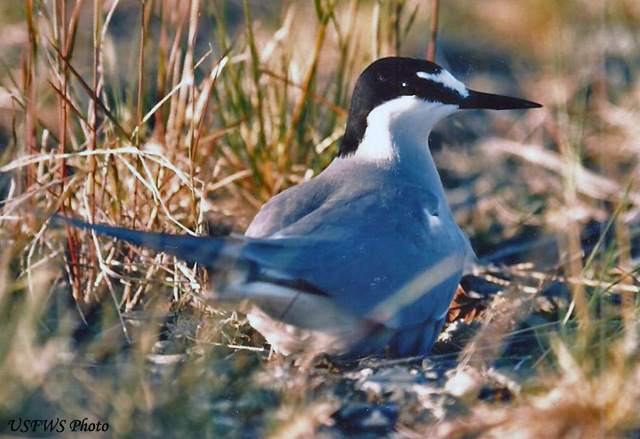
The Aleutian Tern is a less common companion to the Arctic Tern, often found in close association with the Arctic Tern, but typically in much smaller numbers. They are relatively poorly studied, and the wintering range of the species was completely unknown until the 1980s, when some birds were found overwintering in the oceans near Indonesia.
Total populations are relatively small, but given their normal range, there are no serious threats to the species at this time.
Habitat
Outside of the breeding season, Aleutian Terns are pelagic, often found in the open ocean very far from shore. During the summer breeding season, they are found on islands and coastlines of western Alaska, in areas with vegetative cover for nesting sites.
Diet
Feeds on small crustaceans such as euphausiid shrimp, as well as small fish, insects, and other small invertebrates.
Behavior
Foraging is done by flying low over the water's surface, with birds dipping down to the water to grab food items when they see them. Unlike many other tern species, they are not known to plunge-dive for food.
Nesting
The nest of an Aleutian Tern is a depression on the ground, placed amongst vegetation that is close to water. The female lays 1 or 2 eggs, and both parents help to incubate them. When the eggs hatch, both parents feed the young. The young fledge after about one month.
Interactive eBird Map
Click to access an interactive eBird map of Aleutian Tern sightings.
Song
The most common call is a soft descending whistle.
Migration
A long distance migrant, with most birds evidently wintering in the south Pacific, in areas near Indonesia. Summer breeding grounds are restricted to western Alaska and the Aleutians in North America, although some birds also nest in eastern Russia.
Similar Species
Similar to the Arctic Tern.
Conservation Status
Populations are not very large, but they are considered stable. The IUCN lists the Aleutian Tern as a species of "Least Concern".
Further Information
Photo Information
Photo is U.S. Fish and Wildlife photo licensed under Creative Commons Attribution NonCommercial NoDerivs 2.0 Generic License.
