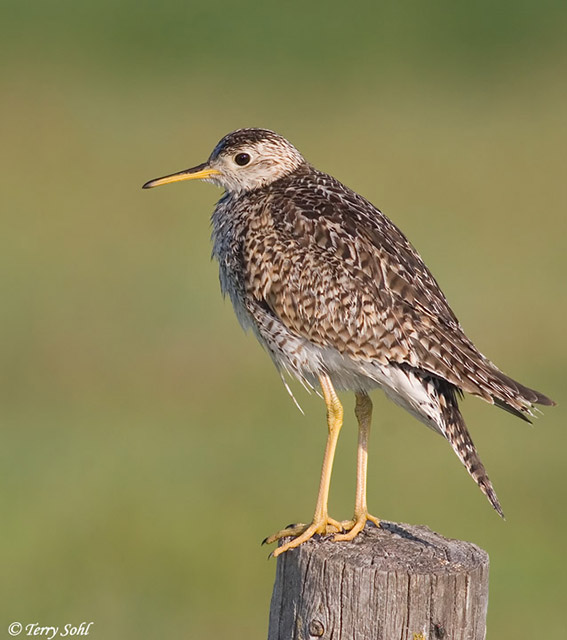
A true sandpiper, but almost never found on mudflats with its cousins, the Upland Sandpiper is a bird of grasslands and prairies. It is most often seen as it perches on fence posts or stumps. Upland Sandpiper males can also often be seen (and heard) during their courtship flights, in which they circle high overhead, singing a loud, carrying song. Adults perform loud distraction displays upon too close of an approach to an active nest.
Habitat
Prefers native grasslands and prairies. In parts of the United States where such habitat is now rare (such as in the Northeast), Upland Sandpipers are most often found around airports and other such areas of with large expanses of managed grasses.
Diet
Primarily insects. Also earthworms, and occasionally, seeds and waste grain.
Behavior
Often perches on fence posts and other elevated perches above the grassland, but when feeding, typically walks through the grassland, picking up food items from the ground or from the surface of the vegetation.
Nesting
Late May through July. The nest of an Upland Sandpiper is a scrape in the ground lined with grasses, placed on the ground in areas of thick grassland. the female usually lays 4 eggs, and both parents help to incubate them. When the eggs hatch, the young leave the nest within hours and feed themselves, but the parents tend to them and protect them. The yong fledge after about one month.
Song
Flight song is a strange bubbling whistle, slowly rising then falling. They also have a rattling call.
- Click here to hear the song of an Upland Sandpiper, recorded in Perkins County, South Dakota1
- Click here to hear the call of an Upland Sandpiper, recorded in Perkins County, South Dakota2
Migration
Summers in the Plains states, the Midwest, and locally in the northeastern U.S., as well as the plains of central and western Canada and up into Alaska. A long-distance migrant, Upland Sandpipers winter in South America.
Interactive eBird Map
Click here to access an interactive eBird map of Upland Sandpiper sightings
Similar Species
As a "shorebird" that inhabits grasslands, their habitat alone makes them rather unique and unlikely to be confused with other shorebird species. However, they could potentially be confused with the following:
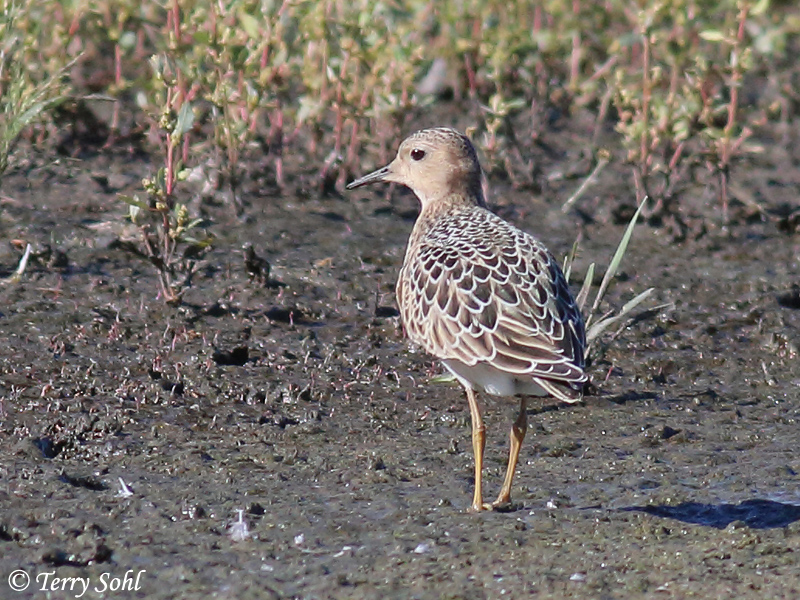
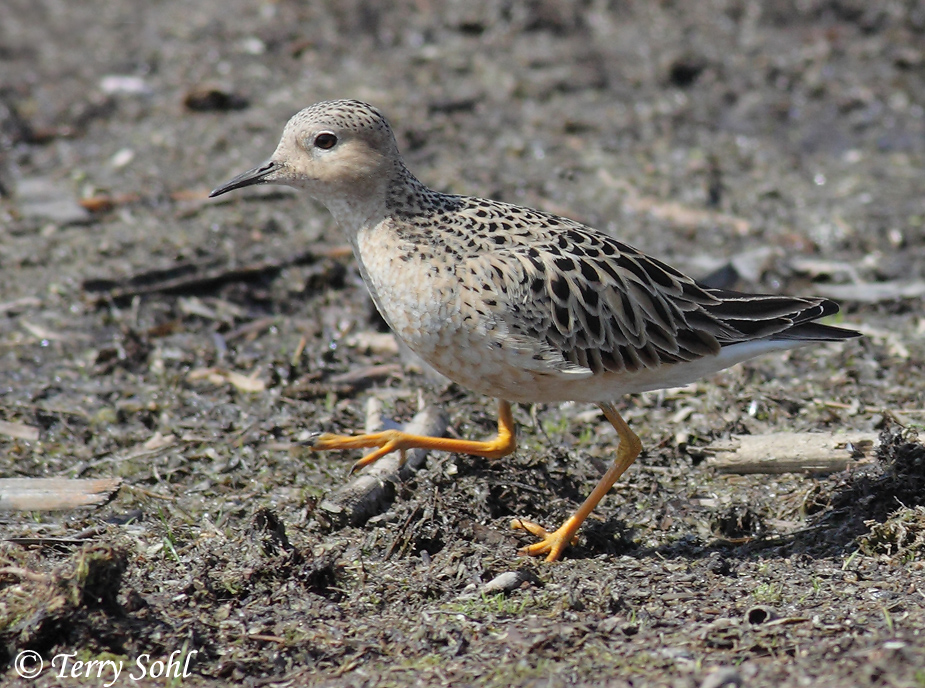
- Buff-breasted Sandpiper - Buff-breasted Sandpipers are but a migrant in South Dakota, but they can sometimes be found on grassy open areas during migration and could potentially be confused with an Upland Sandpiper. However, Buff-breasted Sandpipers are smaller with a shorter neck, and have a dark-colored bill (Upland Sandpipers have a primarily yellow bill).
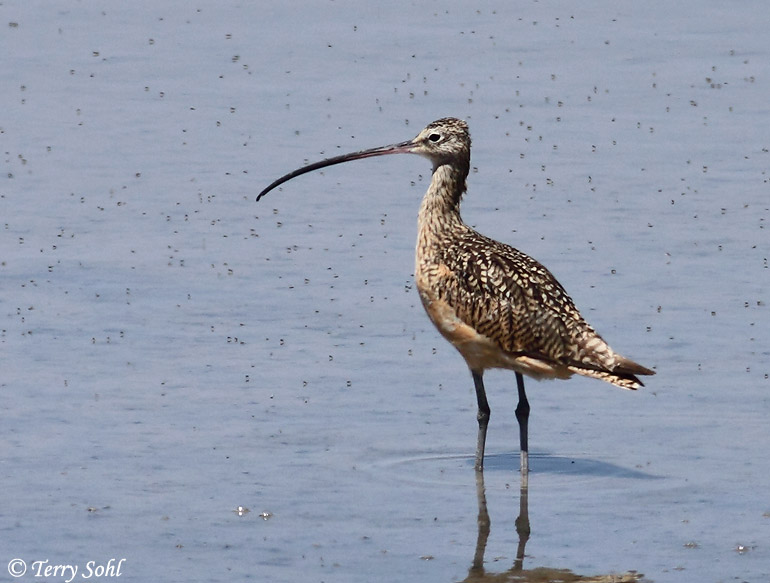
- Long-billed Curlew - Listed here only because Long-billed Curlew is another "shorebird" species that is found on similar grassland habitats as the Upland Sandpiper. From a long distance one may potentially confuse them, but the incredibly long bill, large size, and stockier appearance of the Long-billed Curlew make identification simple if seen well.
 |
 |
 |
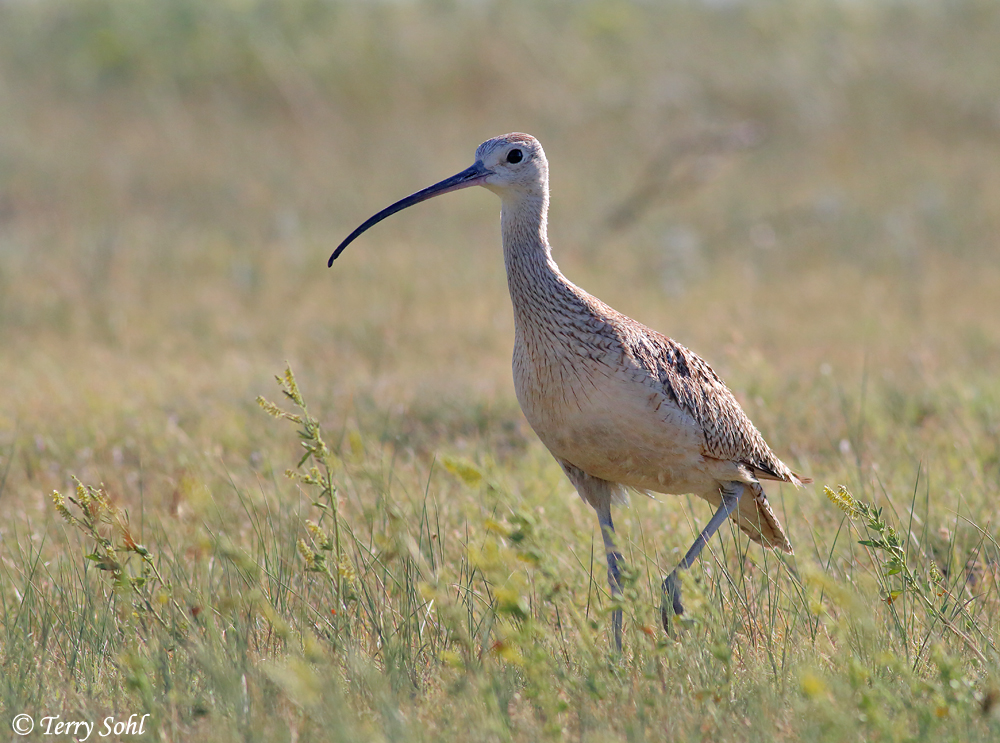 |
| Buff-breasted Sandpiper | Buff-breasted Sandpiper | Long-billed Curlew | Long-billed Curlew |
South Dakota "Hotspot"
Less common in the eastern part of the state, but in much of South Dakota they're a species that's relatively simple to find in the summer months. Given their habit of often perching on fence posts, they're a species that's more observable than most. Fort Pierre National Grasslands is one place where they're very easily observed.
Conservation Status
After being seriously depleted due to hunting in the 19th century, Upland Sandpipers have recovered locally, but are still not as common as they probably once were. Noted declines have occurred in the Eastern United States in the last few decades. After European settlement, widespread clear-cutting of forests created an artificially high amount of open land in the East, likely giving a short-term boost in suitable habitat for Upland Sandpipers. Now, eastern populations may be in decline because that open habitat is disappearing as forests recover. Despite declines locally, overall populations are still not seriously threatened, and may be increasing. The IUCN lists the Upland Sandpiper as a species of "Least Concern".
Photo Information
July 2008 - Minnehaha County, South Dakota -- Terry Sohl
Audio File Credits
- 1Andrew Spencer, XC104331. Accessible at www.xeno-canto.org/104331.
- 2Paul Marvin, XC299641. Accessible at www.xeno-canto.org/299641
