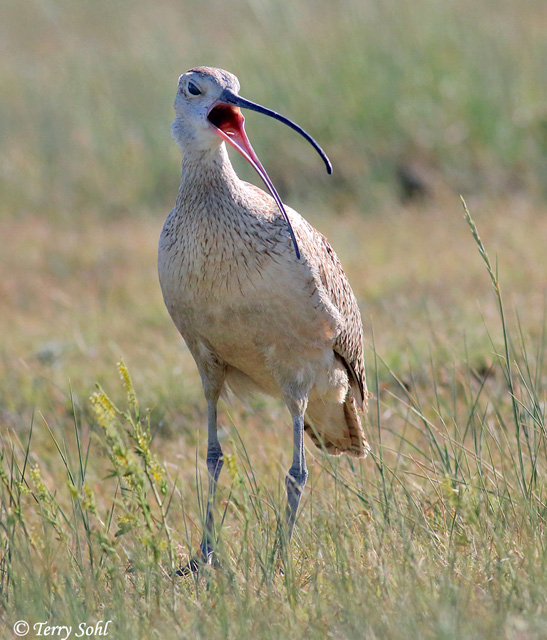
The Long-billed Curlew is the largest of the sandpipers in South Dakota, and is easily recognizable by its extremely long, decurved bill. Their extremely long bills are used to feed on burrowing wolf spiders in South Dakota, with the curve even matching the general shape of a spider burrow. It is a sandpiper of the dry grasslands and prairies of the West, and is only found on mudflats, marshes, and wetlands during migration and in winter. Long-billed Curlews have decreased greatly from their historical range and populations, and are still declining in recent decades.
Habitat
Summers on grassland and sagebrush prairies, preferably with wet meadows nearby. They will use similar habitat in migration and in winter, but many are found in coastal areas, including salt marshes, tidal flats and estuaries, and other habitats more typical of "shorebirds".
Diet
Mostly insects, also eggs, young birds, toads, and occasionally berries and seeds.
Nesting
May and June in South Dakota. The nest of a Long-billed Curlew is a depression on the ground, lined with small amounts of grasses, weeds, and leaves. The female lays between 3 and 5 eggs, and both parents help to incubate them. When the eggs hatch, the young quickly leave the nest, and must find their own food. However, both parents do tend to the young and protect them from harm.
Song
Loud, two-tone call, with 2nd note higher than the first, given both as an alarm call, and a contact call between individual birds. Alarm calls are also sometimes a series of whistled notes. The song of a Long-billed Curlew begins with loud, ascending whistles, followed by a series of rapid whistling vocalizations.
1Click here to hear the song of a Long-billed Curlew, given by a male bird in a flight display during courting, from Comanche National Grasslands in Colorado.
2Click here to hear a calling Long-billed Curlew, from Baja California.
3Click here to hear the flight call of a Long-billed Curlew, from near San Diego.
Migration
Summer breeding grounds are on grasslands and prairies of the interior of the western US and extreme southwestern Canada. In winter, many move to the West Coast of the US, the Gulf Coast, the Atlantic Coast of the US from the Carolinas and southward, and Mexico.
Interactive eBird Map
Click here to access an interactive eBird map of Long-billed Curlew sightings
Similar Species
The length of the bill and the strong downcurve makes them unique and easily identifiable if seen well. But they could potentially be confused with the following species:
- Whimbrel - The only other shorebird species in the state with such a strongly decurved bill, Whimbrels are considerably smaller, have a much shorter bill, and have a strongly patterned, striped crown (Long-billed Curlews have a relatively plain crown).
- Marbled Godwit - Another large "shorebird" that's sometimes seen on grasslands (particularly near ponds and wetlands), the Marbled Godwit may be structurally similar and has a very long bill, but the bill actually has a bit of an upcurve, unlike the strong downcurve of a Long-bileld Curlew.
Conservation Status
Greatly reduced from historical levels, and still declining in recent decades, the range of the Long-billed Curlew was also once much further east than it is today. Grasslands on which it relies have been converted to agriculture in many parts of its range. Despite the recent declines, the species is not currently in threat of extinction, and the IUCN lists the Long-billed Curlew as a species of "Least Concern".
South Dakota "HotSpot"
The species has been a bit of a nemesis bird for me, partly given their range that only extends to the western half of the state. I have seen them a few times on the Fort Pierre National Grasslands, with all but one of those sightings on prairie dog towns west of highway 83. I've also seen them on multiple occasions on the Buffalo Gap National Grasslands further south and west. In terms of time spent birding in both locations, I have little doubt they're more common on Buffalo Gap than on the Fort Pierre grasslands.
Photo Information
June 24th, 2017 - Near Philip, South Dakota - Terry Sohl
Audio Clip Credit
1Andrew Spencer, XC179483. Accessible at www.xeno-canto.org/179483
2Manuel Grosselet, XC339887. Accessible at www.xeno-canto.org/339887
3Paul Marvin, XC451023. Accessible at www.xeno-canto.org/451023
