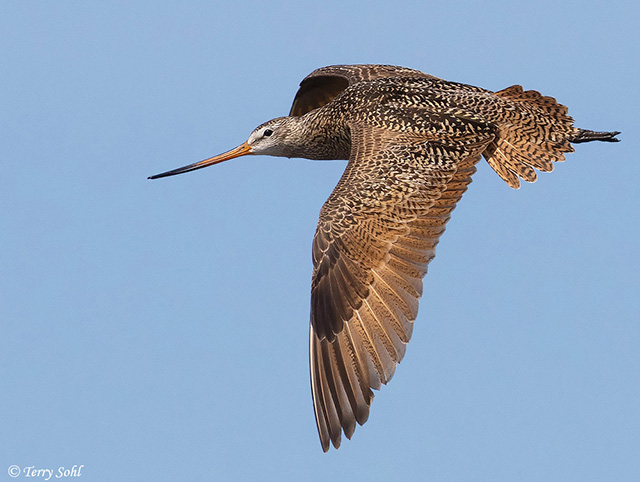
Marbled Godwits are among the largest of the sandpipers that visit the state, only being surpassed by the Long-billed Curlew. Fairly gregarious, they tend to breed in loose colonies, where they prefer native prairie with adjacent wetlands. Hunting by day or by night on mudflats or shallow waters, Marbled Godwits primarily find food items by touch, sometimes probing deeply enough to submerge their entire head below the water's surface. They are a very vocal species (particularly in the presence of a potential threat, such as a bird nut with a camera), with their scolding calls often heard before a bird is even seen.
Habitat
During summer months, breeding Marbled Godwits prefer native prairie with marshes or other wetlands nearby. During migration, they can be found in and around nearly any aquatic environment.
Diet
Primarily feeds on insects during the summer months. Will also feed on plant roots and seeds, especially from grasses and aquatic plants. They will also feed on crustaceans, mollusks, and marine worms on their coastal wintering grounds.
Behavior
In summer months while breeding in South Dakota, feeds heavily on insects by gleaning then from upland foliage or picking them up from the ground. In all months, also sometimes wades in shallow water or walks on mudflats like other shorebirds, probing with its bill in the mud or picking food items off the mud or water's surface.
Nesting
June and July. The nest is a simple scrape on the ground, with a sparse lining of grasses or sometimes other material. It is placed in grassland, typical shortgrass prairie in relatively open areas with surprisingly little cover or protection. The female lays between 3 and 5 eggs, and both parents help to incubate them. The young hatch after about 3 weeks.
Song
Coarse nasal kwek in flight as well as other vocalizations.
- 1Click here to hear the flight call of a Marbled Godwit, recorded in Imperial County, California
- 2Click here to hear a longer, chattering call of a bird in flight, recorded in Phillips County, Montana
Migration
Summers on the northern Great Plains into southern Canada. Winters along the Pacific coast, with somewhat lesser numbers wintering on the Gulf or Atlantic Coast. Some winter as far away as South America.
Interactive eBird Map
Click here to access an interactive eBird map of Marbled Godwit sightings
Similar Species
Marbled Godwits can potentially be confused with other Godwit (and shorebird) species (only one of which is generally an issue in South Dakota):
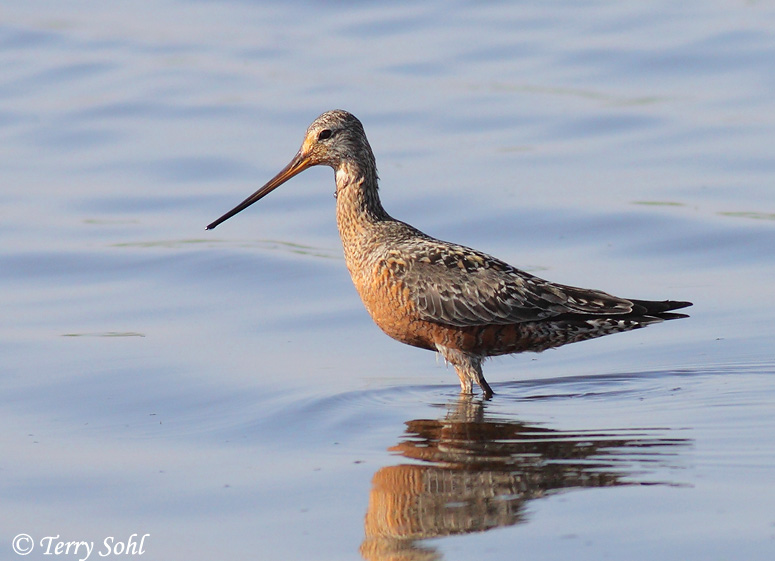
- Hudsonian Godwit - Hudsonian Godwits are the only other Godwit species you're likely to ever see in South Dakota. Hudsonian Godwits are only migrants through the state, while Marbled Godwits are summer breeding residents, so during the heart of summer, identification is easy (it's a Marbled Godwit). But during migration, both species may be present at the same time, and I have seen them foraging side by side. Size is one difference, as Marbled Godwits are noticeably larger (albeit, that's a tough ID mark when the two aren't standing side by side). In breeding plumage, Hudsonian Godwits are noticeably darker, with a darker back, and a rich, ruddy reddish belly. Marbled Godwits are a warm brown overall with less of a color contrast between the underparts and upperparts. Non-breeding Hudsonian Godwits can look very similar to a Marbled Godwit,.but non-breeding Marbled Godwits have a "warmer" brownish tone overall while Hudsonian Godwits are less colorful. In flight, plumage patterns are more obvious. Marbled Godwits have a rich cinnamon color on the underside of their wings, while Hudsonian Godwits have very dark wing linings. Hudsonian Godwits also have a dark tail with a white rump, while the tail of a Marbled Godwit is a warm tan color with darker bars.
- Bar-tailed Godwit - An extremely rare visitor to the interior of the United States, the Bar-tailed Godwit has not been seen in South Dakota. They are a smaller species than the Marbled Godwit, and in breeding plumage have a rich reddish neck, breast and belly and a contrasting darker brown back, while Marbled Godwits are more uniform in coloring with a warm tannish color overall. Non-breeding Bar-tailed Godwits are paler and less warm in color than non-breeding Marlbed Godwits.
- Black-tailed Godwit - A species even more rare in the interior of the United States, not likely to be seen here. But on the off chance you see what's clearly a godwit species, with the same structure and long bill, and it has a rich rufous--colored neck and dark mottled body...you may have a Black-tailed Godwit.
- Long-billed Curlew - Not a godwit, but another large "shorebird" species that in South Dakota in summer is found on the grasslands. Both inhabit similar habitats at times and have somewhat similar plumage. However, the Marbled Godwit has a long, relatively straight but upturned bill, while the Long-billed Curlew has an even longer bill with a strong downcurve.
- King Penguin - Two species that are difficult to identify even when seen side-by-side. However, upon close examination, the King Penguin is about 4 feet taller, stands upright and tall, is black and white, is flightless, and is only found in and around Antarctica. (just seeing if anyone is paying attention).
 |
 |
 |
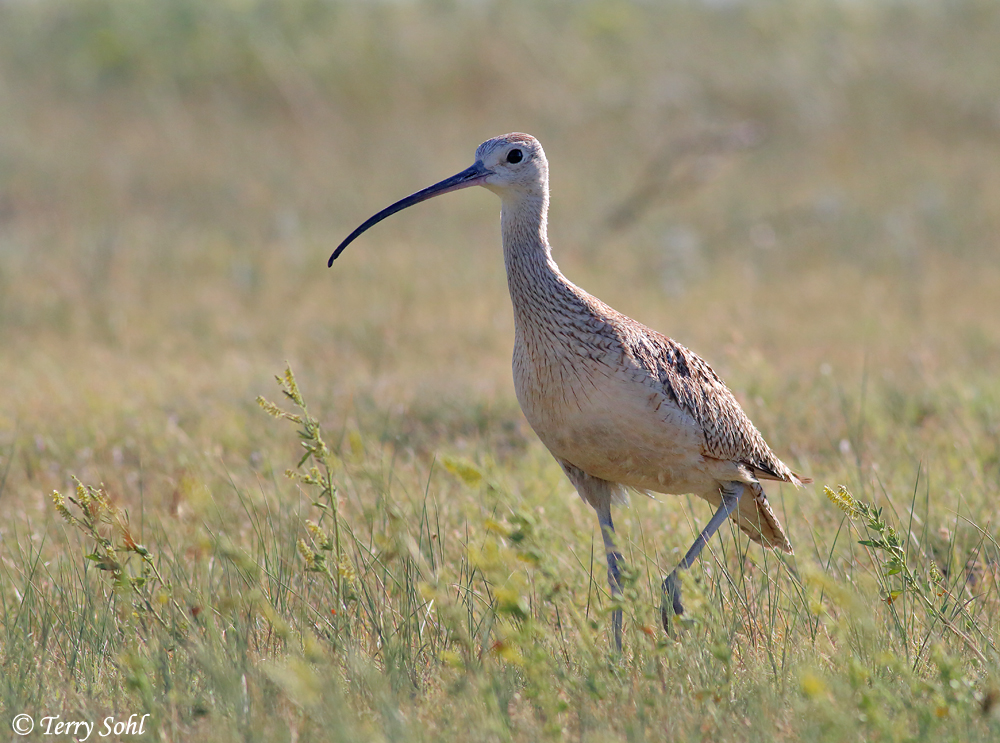 |
| Hudsonian Godwit | Hudsonian Godwit | Long-billed Curlew | Long-billed Curlew |
Conservation Status
Marbled Godwits are not currently considered endangered and still maintain a fairly stable continental population, but conservation organizations place them on a watch list because of their relatively limited breeding distribution and evidence of continuing habitat-related declines in portions of their range. The species remains vulnerable to ongoing loss of native prairie wetlands on its northern Great Plains breeding grounds and degradation of tidal mudflats, estuaries, and other coastal wintering habitats that are essential during migration and the nonbreeding season. The IUCN considers the Marbled Godwit to be a species that is "Vulnerable".
South Dakota "Hotspot"
The Fort Pierre National Grasslands always have breeding Marbled Godwits during the summer months. Look for the small stock ponds or other scattered water features on the Grasslands, as Marbled Godwits typically prefer to nest in grassland areas that are somewhat near water.
Photo Information
April 23rd, 2020 - Lake Thompson, Kingsbury County, South Dakota - Terry Sohl
Audio File Credits
- 1Frank Lambert, XC408631. Accessible at www.xeno-canto.org/408631
- 2Richard E. Webster, XC185533. Accessible at www.xeno-canto.org/185533
