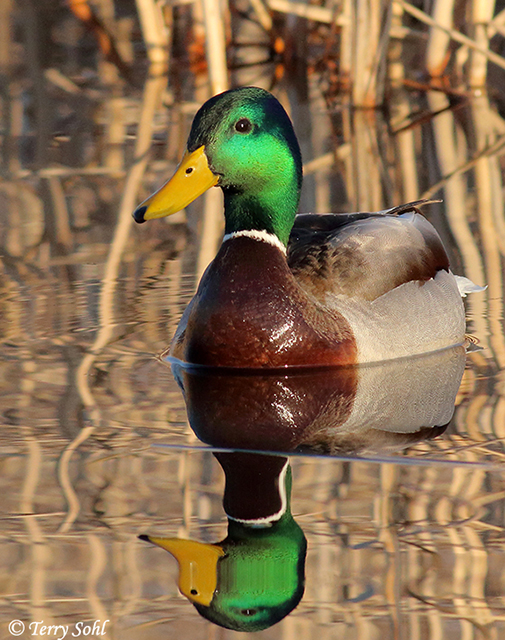
Mallards are probably the most familiar duck to most, given how well-adapted they are to living around human activity. Many semi-domesticated Mallards have learned to live on handouts around city parks and ponds. The Mallard is also the ancestor of the vast majority of domestic ducks.
Mallards have several sub-species and closely related species, including the "Mexican Duck" and the "Hawaiian Duck", with unique species status dependent upon source, In much of the eastern United States, they are most closely related to American Black Ducks, a species in decline in part due to competition with the more adaptable Mallard, and due to direct cross-breeding between the two species.
Habitat
The Mallard inhabits a wide variety of wetlands including marshes, ponds, lakes, rivers, reservoirs, prairie potholes, and flooded fields. It is highly adaptable and is also common in urban parks, golf courses, suburban ponds, and other human-modified landscapes where open water and nearby feeding areas are available.
Diet
Primarily plant material, such as grasses, pond weeds, grasses, sedges, seeds, grain, and roots. Also will eat insects, small fish, earthworms, frogs, tadpoles, and snails.
Behavior
Primarily forages by dabbling on the water's surface...upending and submerging its head and neck. They will rarely dive for food. They also will forage by walking on land.
Nesting
Mid-April through August. The bowl-shaped nest of a Mallard is constructed of vegetative material, lined with the bird's own down. The female usually lays between 6 and 10 eggs, and she does the incubation. When the eggs hatch, the young leave the nest within a day and feed themselves, but the female protects them. The young first take flight after about 8 weeks.
Song
Surprisingly, a duck-like quack-quack-quack
- Click here to hear the call of a male Mallard as it is taking flight1
- Click here to hear the alarm call of a female Mallard2
Migration
Spring migration is typically in March, but variable numbers of Mallard will remain in South Dakota in the fall and winter as long as open water and food are available.
Interactive eBird Map
Click here to access an interactive eBird map of Mallard sightings
Bird Feeders
Will feed on corn or grain scattered on the ground.
Similar Species
Male Mallards are distinctive and unlikely to be confused with another species, if seen well. Female Mallards could be potentially confused with other dabbling duck species.
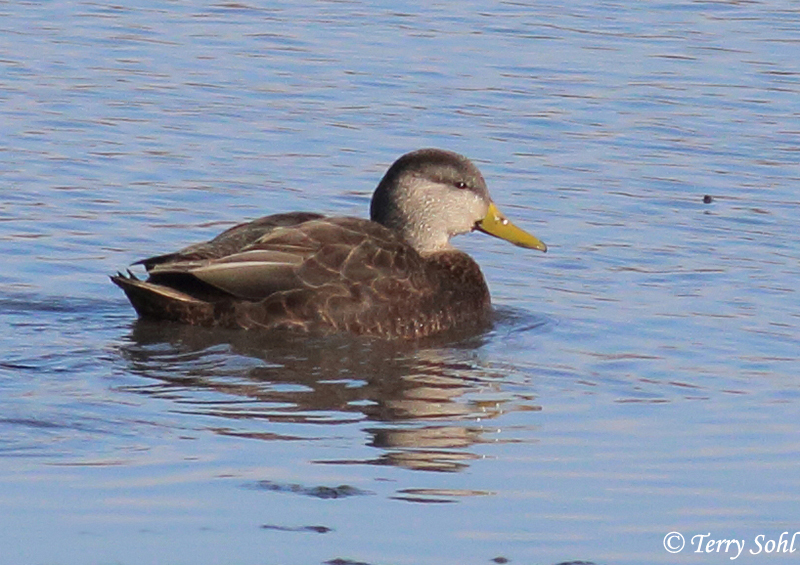
- American Black Duck - A close relative of the Mallard that has been displaced by it in parts of its range, males and females could potentially be confused with female Mallards. Bill color is a primary clue, as female Mallards have orange bills, female American Black Duck have dull grayish-yellow bills, and male American Black Ducks have brighter yellow bills. Female Mallards also have white bordering the colorful purplish wing patch, with the border lacking on American Black Ducks of both sexes.
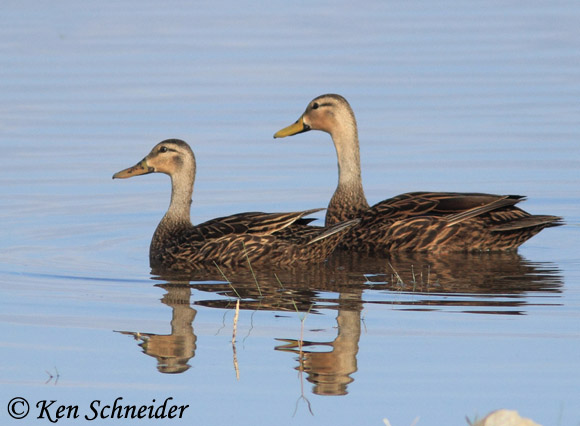
- Mottled Duck - Mottled Duck are a species not found in South Dakota, but in range (Gulf Coast and Florida) they could be confused with Mallards. Females are very similar, but Mottled Ducks have a much plainer face, while Mallards have dark speckling and markings on a lighter background. Male Mottled Ducks have a yellow bill that may match color of a male Mallard, but they lack the green head. Male Mottled Ducks thus could also be confused with a female Mallard, but for the yellow bill on the Mottled Duck male, and the plain face.
- Blue-winged Teal - Males of both species are easily differentiated, but the plainer females could be confused, particularly as Mallards and Blue-winged Teals are often the two most common duck species in South Dakota and are often found in the same habitats. Female Blue-winged Teal have a black bill, while female Mallards have an orange-marked bill.
 |
 |
 |
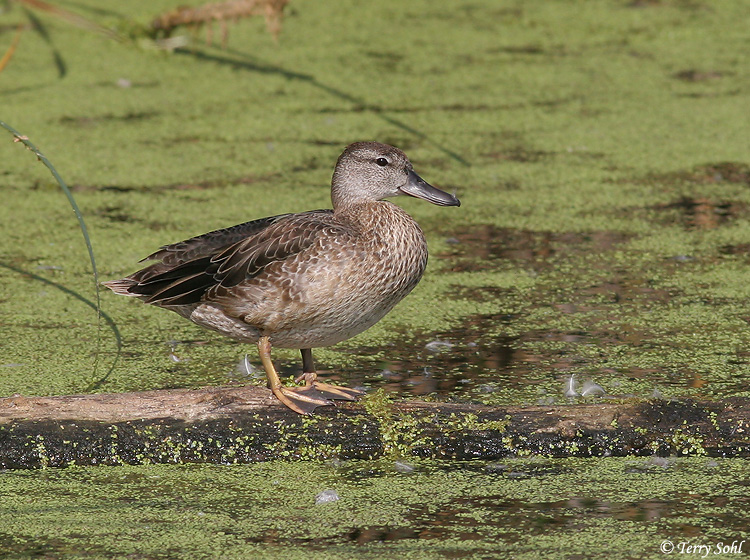 |
| American Black Duck | American Black Duck (with a Mallard pair) | Mottled Duck | Blue-winged Teal (female) |
Conservation Status
Very common and widespread, adapted well to a human presence. Mallard have an extremely wide geographic range across multiple continents, and are very common in many parts of that range. At a global level, the the IUCN lists the Mallard as a species of "Least Concern".
South Dakota "Hotspot"
Mallards typically aren't difficult to find, although in today's heavily populated world, the well-adapted Mallard is actually easier to find in urban areas than in more natural settings. They are often found as semi-tame birds in and around urban parks, golf courses, and other urban settings with water features.
Photo Information
April 15th, 2018 - Lincoln County, South Dakota - Terry Sohl
Audio File Credits
- 1Alain Malengreau. Recorded in Belgium on May 3rd, 2020. Original recording and information from xeno-canto.
- 2Niels Van Doninck. Recorded in Belgium on March 26th, 2020. Original recording and information from xeno-canto.
