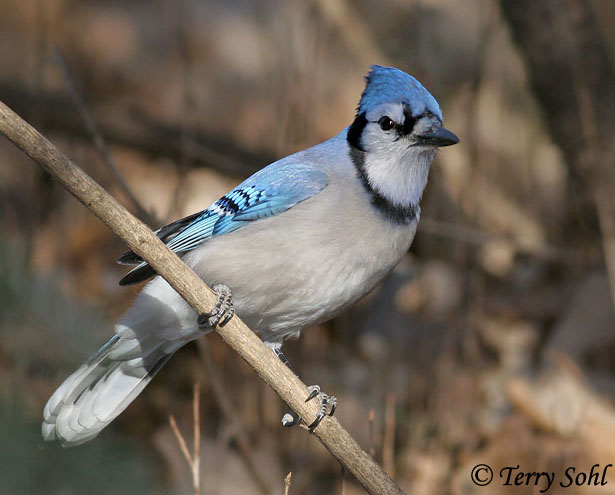
Blue Jays are brash, sometimes noisy, commonly recognized birds often found in urban settings. Blue Jays feed on a wide array of items, and will readily attend residential feeders for most commonly offered foods. They are extremely intelligent, and are quick to adapt to new situations when foraging opportunities present themselves.
Habitat
Breeds in deciduous to mixed forest, never pure conifer stands. Can be found in a wide variety of woodland and forest settings, including unbroken forest, forest edges and clearings, residential areas and parks, and shelterbelts.
Diet
Omnivorous, feeding on nuts, acorns, pine seeds, other seeds, waste grain, fruit and berries, insects, eggs and young birds, small rodents, small reptiles, small amphibians, carrion.
Behavior
Blue Jays will use a very wide variety of techniques for foraging, with individual birds often specializing in a certain foraging technique and food item. They will feed from the ground to the top levels of a forest canopy, at bird feeders, at carrion along a roadside, etc.
Nesting
May and June in South Dakota. The nest is a cup built of sticks, grasses, weeds, moss, and sometimes mud, built in the crotch of a tree or on a tree branch, usually from 8 to 30 feet from the ground. The female usually lays 4 or 5 eggs, and both parents help to incubate them. After the eggs hatch, both parents help to raise and feed the young, who leave the nest after about 3 weeks.
Song
Blue Jays have an extremely wide array of vocalizations, from the typical harsh jeeeer! calls known by many, to a variety of whistles, clucks, or harsh warbling sounds. Click on some of the links below to hear the various vocalizations of a Blue Jay.
1Click here to hear the typical jeer call of a Blue Jay
2Click here to hear a "rusty pump handle" call of a Blue Jay
3Click here to hear a Blue Jay seemingly imitating the call of a Cooper's Hawk
4Click here to hear a short "yelp" call of a Blue Jay
5Click here to hear a Blue Jay agitated by a Sharp-shinned Hawk
Migration
Generally a permanent resident, with some occasionally moving south in the fall.
Interactive eBird Map
Click to access an interactive eBird map of Blue Jay sightings
Similar Species
With their unique plumage and small crest, Blue Jays aren't likely to be confused with another species, if seen well. In South Dakota, identification is even easier, as there's only one other jay species potentially confused with a Blue Jay that's been seen in the state, and it's an extremely rare visitor. In other parts of North America, there are additional Jay species that could conceivably cause confusion.
- Steller's Jay - Steller's Jay are another blue, crested Jay species that can potentially be found in South Dakota. However, they are primarily a bird of the western United States, and are only extremely rare visitors to the Black Hills of western South Dakota. Despite blue coloring and a crest, their overall appearance is quite different. Blue Jays have blue upperparts and light underparts, while a Steller's Jay has bluish upperparts and underparts. The head of a Blue Jay is white, with a black band from neck to nape, and a blue crest. The head of a Steller's Jay is black, with a long black crest.
- Woodhouse's Scrub Jay - Not a bird likely to be seen in South Dakota, Woodhouse's Scrub Jays range is in the western US, with the closest populations found in central Colorado. Like a Blue Jay, they have blue upperparts and a lighter belly, but Blue Jays have a crest, a white face, and a black neck-to-nape band that is lacking from a Woodhouse's Scrub Jay.
- Florida Scrub Jay - Florida Scrub Jays have a limited range in Florida, where they are found in scattered locations throughout the state. Their range does overlap with the Blue Jay and is thus a potential source of confusion. Both have blue upperparts and lighter underparts, but the Florida Scrub Jay has a light patch on the back that's lacking from a Blue Jay. Blue Jays also have a crest, and a black neck-to-nape band that's lacking from a Florida Scrub Jay.
Bird Feeders
Blue Jays will attend feeders for a variety of items, with their favorites being sunflower seeds, suet, nuts
Conservation Status
When the West Nile virus first appeared in North America, Blue Jays were one of the birds most heavily impacted, with severe local declines in parts of their range. However, numbers have rebounded as they've seemingly started to adapt to the virus. Overall populations are considered stable, they are spread over a very wide geographic region, and are common in many areas. The IUCN lists the Blue Jay as a species of "Least Concern".
Further Information
- eBird - Blue Jay
- Audubon Field Guide - Blue Jay
- Cornell Lab of Ornithology - All About Birds: Blue Jay
Photo Information
November 15th, 2007 - Big Sioux Recreation Area near Brandon, South Dakota - Terry L. Sohl
Audio File Credits
1Christopher McPherson. Recorded in Hillsborough County, New Hampshire on February 23rd, 2020. Original recording and information available from xeno-canto.
2Jim Berry. Recorded in Chautauqua County, New York on June 1st, 2020. Original recording and information available from xeno-canto.
3Bobby Wilcox. Recorded in Des Moines, Iowa on April 13th, 2019. Original recording and information available from xeno-canto.
4Bates Estabrook. Recorded in Anderson County, Tennessee on February 4th, 2017. Original recording and information available from xeno-canto.
5Paul Driver. Recorded near Montgomery, Pennsylvania on October 14th, 2010. Original recording and information available from xeno-canto.
