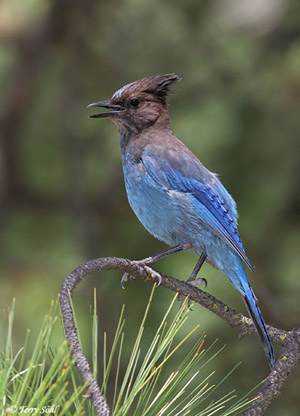
The Steller's Jay is the only crested Jay of the Western United States, where the Blue Jay is absent. There are cases of Steller's Jays and Blue Jays interbreeding in their overlapping ranges of the Eastern Rockies. Steller's Jays are bold campground robbers, but otherwise are generally shy, retiring birds of dense Western forests. They are very rare visitors to South Dakota.
Habitat
Primarily conifer and mixed forests, much less common in groves of deciduous trees.Diet
Omnivorous. Eats large numbers of nuts and seeds, especially pine seeds and acorns. Also eats fruits and berries, insects, frogs, snakes, small lizards, eggs and young birds, small rodents, carrion, and garbage.Behavior
Most often forages high in the forest canopy for nuts and seeds, but will also forage lower in the canopy or along the ground for other items. They can be extremely bold around campsites and picnic areas in search of human food.Breeding
Non-breeder in South Dakota. The Steller's Jay nests in dense coniferous or mixed woodlands, where the pair builds a bulky cup of sticks, roots, mud, and moss well hidden in a tree. The female usually lays 3 to 5 eggs, and both parents help feed the young, aggressively defending the nest area from squirrels, crows, and other intruders.Song
The Steller's Jay is a loud, expressive bird best known for its harsh, repeated shak-shak-shak and scolding screams that ring through western forests. It also gives rattles, clicks, whistles, and surprisingly accurate imitations of hawks or other birds.
Steller's Jay Call