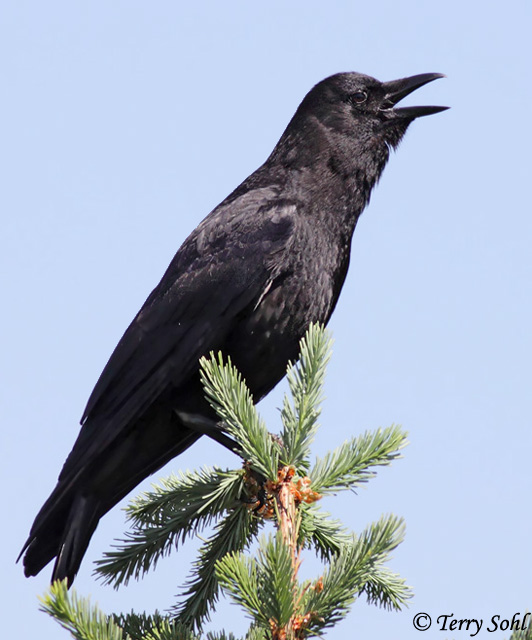
The American Crow is one of the most widespread and adaptable birds in North America. Its call of caw-caw is widely familiar, as is the distinctive slow flapping flight. An intelligent bird, the American Crow has survived widespread persecution, and has adapted to most human-altered landscapes. They can be just as well adapted to heavily altered landscapes such as agricultural land or urban settings as they are to natural landscapes.
Habitat
Wide variety of open to semi-open habitats, from rural agricultural areas to city parks.
Diet
Omnivorous. Will eat a very wide array of items, including seeds, waste grain, berries and other fruit, insects, earthworms, snails, frogs, small snakes and lizards, small rodents, crustaceans, mollusks, eggs and young birds, garbage, and carrion.
Behavior
Extremely intelligent and opportunistic, with individual birds or groups of birds often specializing in specific foraging techniques. Wide variety of behaviors depending upon location and situation.
Nesting
April through June. The nest of an American Crow is a large basket of sticks, weed stems, bark strips, and mud, lined with softer material such as mosses, leaves, grasses, feathers, and animal hair. The female lays between 3 and 8 eggs, and she does most, if not all, of the incubating. When the eggs hatch, both parents help feed the young, and they are sometimes assisted by "helper" birds in a cooperative nesting behavior. The young leave the nest after about 4 weeks.
Interactive eBird Map
Click to access an interactive eBird map of American Crow sightings
Song
Migration
Generally a permanent resident throughout the majority of the United States. Those in the extreme northern U.S. and in Canada move south in the fall.
Similar Species
In range, most likely to be confused with the Common Raven or Fish Crow or Chihuahuan Raven. The American Crow is the familiar, medium-sized all-black crow of towns, farms, shelterbelts, and woodlands, giving a clear, even caw-caw and showing a fairly smooth throat when calling. Fish Crow is slightly smaller and often harder to separate visually, but its nasal, short uh-uh call is distinctive; it is most often found near coasts, rivers, wetlands, and the southeastern U.S. Common Raven is much larger and heavier-billed than any crow, with a shaggy throat, wedge-shaped tail, and deep croaking calls, often soaring high over open country, cliffs, or mountains. The Chihuahuan Raven is smaller and more slender than a Common Raven but larger than a crow, usually inhabiting dry grasslands and desert regions of the Southwest; it has a relatively narrow bill, white feather bases on the neck (difficult to see unless wind or other movement exposes feather bases), and a nasal, gruff call unlike the richer croak of the Common Raven.
Conservation Status
Extremely adaptable, the American Crow has withstood countless attempts at eradication. It has adapted well to living with humans and is probably more abundant today than it has ever been. They are found over a wide geographic region, and they are very common in many areas. The IUCN lists the American Crow as a species of "Least Concern".
Further Information
Photo Information
June 2009 - Central Oregon - Terry Sohl
