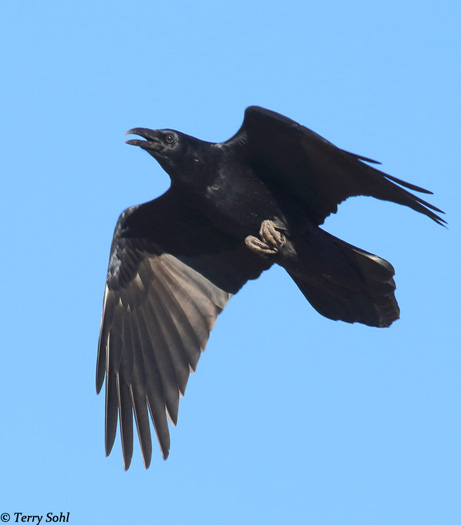
The Chihuahuan Raven is found in the arid grasslands of the southwestern United States and Mexico, in habitats not often frequented by their larger and more common relatives, the Common Raven. While similar in appearance to the Common Raven, they are significantly smaller, but have a proportionally more stout bill. As with other Corvid species, they have adapted well to a human presence, and are a common sight at garbage dumps and other locations where they can feed on human refuse.
Habitat
Found in arid grasslands of the southwestern United States and Mexico. They can also be found in low-elevation shrublands.
Diet
Omnivorous, feeding on a large proportion of animal matter, but also feeding on vegetation. Food items include large insects and spiders, bird eggs and young birds, earthworms, small rodents, small lizards, small snakes, grain, seeds, fruit, berries, carrion, and refuse.
Behavior
Foraging techniques depend upon location and available food items. Much of their foraging is done on the ground, but they will also forage in the branches and foliage of trees and shrubs.
Nesting
The nest of a Chihuahuan Raven is a large platform of sticks, lined with softer material such as bark fibers, grasses, and animal hair. The female lays between 4 and 7 eggs, and both parents help to incubate them. When the eggs hatch, both parents help feed the young, who leave the nest after about one month.
Song
Has a relatively high-pitched croaking call that usually rises slightly in pitch toward the end.
Migration
Considered a permanent resident throughout much of its range. However, some birds in the do move southward for the winter.
Similar Species
Similar in appearance to the Common Raven, and could also be confused with the American Crow or Tamaulipas Crow in range. The Chihuahuan Raven is an intermediate-sized black corvid of arid grasslands and desert plains in the Southwest, larger and longer-winged than the American Crow but clearly smaller and more slender-billed than the massive Common Raven. Unlike the Common Raven, it has a less shaggy throat, a lighter nasal call, and often shows pale feather bases on the neck in strong wind; compared with the American Crow it looks rangier, with a heavier bill and longer tail. In southern Texas and northeastern Mexico it can overlap with Tamaulipas Crow, but Tamaulipas Crow is smaller, more crow-like, with a shorter bill, glossier plumage, and higher, sharper crow-like calls rather than the gruff nasal notes of Chihuahuan Raven.
Conservation Status
Populations are large, spread over a wide geographic area, and appear to be stable. The IUCN lists the Chihuahuan Raven as a species of "Least Concern".
Photo Information
Photo taken on November 10th, 2015 - Las Cinegas Natural Resource Area, southeast of Tucson, Arizona - Terry Sohl
Interactive eBird Map
Click to access an interactive eBird species sightings page for Chihuahuan Raven
