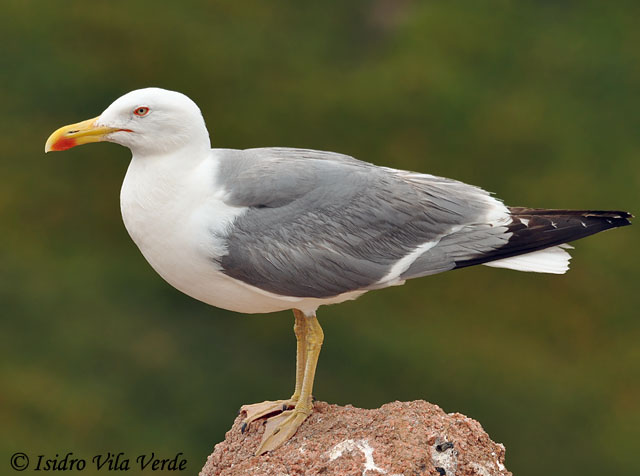
ID Keys: Yellow legs, large yellow bill, gray wings with black and
white contrasting tips, white body and head
The
Yellow-legged Gull is very similar to the
Herring Gull, and was once considered a race of the Herring Gull
species. The yellow legs separate the Yellow-legged Gull from the
pink-legged Herring Gull, as do slight differences in mantle color and
wingtip patterns. The mantle color of a Yellow-legged Gull is lighter
than the similar Lesser
Black-backed Gull. There was significant confusion about the
species' status in North America, as some North American sightings of what
were undoubtedly Yellow-legged Gulls were assumed to be hybrid Herring and
Lesser Black-backed Gulls, a cross which has been confirmed.
Yellow-legged Gulls are natives of southern Europe, northern Africa, and the
Middle East, and are but rare visitors to North America, with most sightings
occurring in the northeastern part of the United States.
Habitat
Found in a variety of habitats both
during and outside of the breeding season. When breeding, colonies may
occur on rocky shorelines, on offshore islands, near freshwater wetlands and
water bodies, or brackish marshes. Outside of the breeding season,
they are found near a wide variety of aquatic habitats.
Diet
Omnivorous, feeding on a variety of food
items, including fish, crustaceans, mollusks, insects, small vertebrates,
eggs and young birds, carrion, and refuse.
Behavior
Gregarious in all seasons, nesting in
colonies, and typically found in groups outside of the breeding season as
well. Foraging method depends upon location and food item being
pursued. They have adapted well to a human presence, and can often be
found at garbage dumps or in other areas where human refuse is available.
Nesting
Yellow-legged Gulls are colonial nesters.
The nest is a mound of vegetation, feathers, and other material, depressed
in the center, and placed on the ground, in a rocky crevice, on a cliff
ledge, or even on man-made structures such as buildings. The female
usually lays 3 eggs. The young fledge after about 5 weeks.
Song
The common call of a Yellow-legged Gull is a
rough low kaw.
Migration
Many birds are permanent residents in
their normal European and African range. However, some birds move to
more temperate climates for the winter, departing for southwestern Europe or
North Africa.