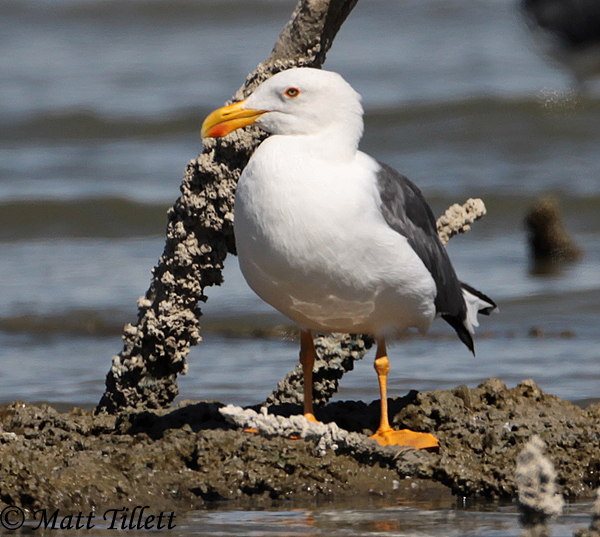
ID Keys: Dark gray back, white head and underparts, red dot on lower
mandible, large heavy bill, bright yellow legs
The
Yellow-footed Gull is a large gull species with a small geographic range,
nesting only in and around the Gulf of California and the Baja Peninsula.
In the United States, they are regular post-breeding visitors to the Salton
Sea in southern California, but total number of birds found in the United
States is typically quite small.
Habitat
Found near the shoreline in most seasons,
rarely venturing far out to sea. Found on open shorelines of the
Salton Sea when they visit the United States.
Diet
Feeds heavily on fish, but will also feed on
crustaceans, mollusks, marine worms, eggs and young birds, carrion, and
refuse.
Behavior
Foraging behavior depends upon food item
and location. They will walk in terrestrial habitats, swim on the
ocean's surface and pluck items near the surface, or sometimes will make
short plunges into the water.
Nesting
A colonial nester, the nest of a
Yellow-footed Gull is a shallow scrape on the ground, lined with seaweed and
other plant material, placed on a beach near the high tide line. The
female usually lays 3 eggs, and both parents help to incubate them.
When the eggs hatch, both parents help to raise the young. The young
fledge about 6 weeks after hatching.
Song
Has a steady, nasal voice, less harsh than
many gull species.
Migration
Considered a permanent resident in and
around the Gulf of California. Small numbers move northwards after breeding
season, reaching the Salton Sea in California.
Similar to Western Gull, but leg color
differentiates the two species. The
Lesser Black-backed Gull also has a dark mantle and bright yellow legs,
but is considerably smaller with a less heavy bill.