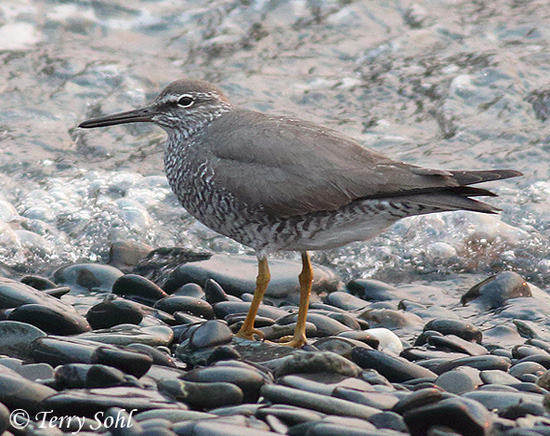
ID Keys: Slate gray overall, lighter below, black and white stripe
in front of eye, heavy barring on breeding birds
The
Wandering Tattler is named for it's loud "tattling" call given when a bird
is disturbed and takes flight. It takes the title of "Wandering"
Tattler due to the wide geographic range on which they can be found. They
are only found in Alaska and northwestern Canada during the summer breeding
season, but wintering birds can be found on rocky coastlines of much of
western North America, with some moving as far south as the western coast of
South America.
Habitat
Found near rocky mountain streams during
the summer breeding season. In migration and in winter, found on rocky
coastlines, including man-made rocky structures such as breakwaters and
piers.
Diet
Feeds on insects, mollusks, crustaceans,
marine worms, and other small invertebrates. Insects make up much of
the diet during the breeding season.
Behavior
Forages by quickly walking along rocks,
stopping to pick up food items when they are spotted.
Nesting
The nest of a Wandering tattler is a
depression on the ground, sometimes lined with grasses, leaves, and twigs,
or sometimes unlined. The female usually lays 4 eggs, and both parents
help to incubate them. When the eggs hatch, the young leave the nest
almost immediately and start searching for their own food. Both
parents tend to and protect the young for the first couple of weeks, but
typically only one parents remains after that.
Song
Flight call of a Wandering Tattler is a
clear piping trill. The flight song given on breeding grounds is a
whistling deedle-deedle-deedle-deeee.
Migration
Migratory. Breeding birds in North
America are found in Alaska and in northwestern Canada. Wintering
birds can be found along the coast of from southwestern Canada, all the way
down to the northwestern coast of South America.
Most likely to be confused with the Willet,
particularly in non-breeding plumage, when barring on the underparts isn't
present.
Conservation Status
The Wandering Tattler is generally considered stable across much of its range, but its relatively small global population and dependence on specialized coastal habitats make it potentially vulnerable to shoreline disturbance, sea-level rise, and habitat degradation. Conservation concerns focus on protecting rocky coastal migration and wintering habitats, as well as maintaining healthy stream and alpine breeding environments in remote northern regions.
The IUCN lists the
Wandering Tattler as a species of "Least Concern".
Photo Information
Photo taken on May 20th, 2014
near Homer, Alaska - Terry Sohl