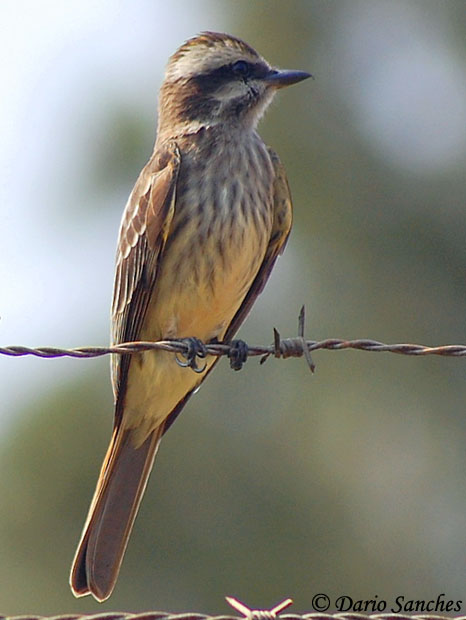
ID Keys: Dark upperparts, pale yellow underparts, streaks on chest,
strong white and dark striping on head
The
Variegated Flycatcher is a species found in South America. The first
confirmed sighting of one in North America occurred in 1977 in Maine, and
since then, strays have also shown up in Ontario, Tennessee, Florida, and
Washington state.
Habitat
Found in a variety of forested habitats,
particularly along forest edges and clearings.
Diet
Feeds heavily on insects and spiders, but
will also take fruits and berries.
Behavior
Forages by observing from a perch, and
flying out to capture insects in mid-air.
Nesting
The nest of a Variegated Flycatcher is a
cup of sticks, grasses, and bark strips, placed on the horizontal branch of
a tree. The female usually lays 3 or 4 eggs, and she alone incubates
the eggs.
Song
Song of a Variegated Flycatcher is a
chee-chee-chooo.
Migration
Variegated Flycatchers are permanent
residents in much of their South American range, but one sub-populations
that breeds in southern South America is a relatively long-distance migrant,
moving to northern South America outside of the breeding season.. It
is assumed that vagrants in North America are from the migratory
sub-populations in South America.
Unusual compared to most North American flycatchers. Most similar to
the Sulphur-bellied Flycatcher,
a species that can be found in western Mexico, and southern Arizona and New
Mexico.