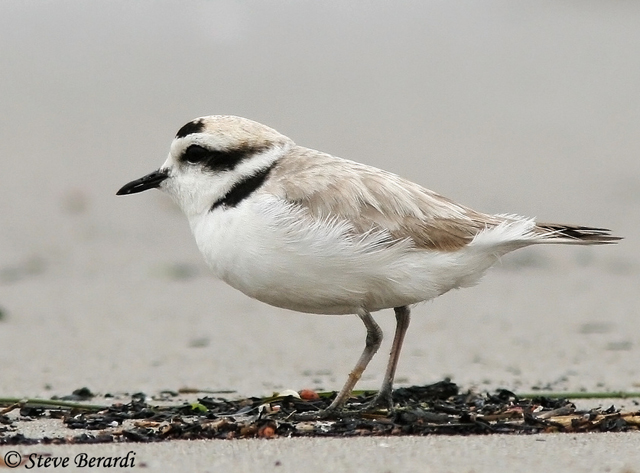
ID Keys: Lightest of the plovers, thin bill, gray legs, incomplete
breast band
The Snowy Plover is the palest of the North
American plovers, and also the smallest. Inland, they usually nest on open
salt flats or other similarly barren areas. On the coastlines, however,
they nest on sandy beaches, where their nests are often disturbed by human
visitors. As a consequence, they are considered threatened in many coastal
locations. Their normal summer breeding ground on the interior of the continent
only reach northward to Kansas, and they are thus rare visitors to
South Dakota. However, in recent years, very small numbers have been found
in South Dakota in summer, with confirmed breeding.
Habitat
Prefers
very open habitats with little vegetation, especially dry salt flats and sand
beaches.
Diet
Insects make up the majority of the diet for those birds
nesting inland. Those along the coasts feed on crustaceans, mollusks,
marine worms, and insects.
Behavior
Feeds in typical plover fashion, running
several steps with intermittent pauses, grabbing food items when spotted.
Nesting
Normal summer breeding grounds were
thought to extend only to northern Kansas. However, in the past few
years, there has been confirmed breeding within South Dakota. The nest is
a simple scrape in the ground, lined with bits of vegetation and pebbles.
The female lays 3 eggs, and both parents help to incubate them. After the
eggs hatch, both parents help tend to the young, but the young leave the nest
almost immediately and find their own food.
Song
Whistling pee-e-eep.
Migration
Summers along the Pacific and Gulf
coasts, in and around salt lakes and alkaline flats in the western interior
of the U.S., and on the southern plains. Those on the coasts are
mostly permanent residents, but those in the interior move to the coastlines
in the winter.