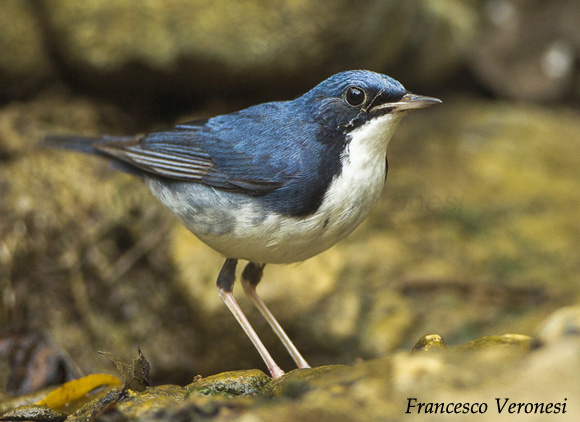
ID Keys: Males deep blue upperparts, white underparts females
brownish upperparts. Long legs, strong pale bill
The
Siberian Blue Robin is a brilliantly colored songbird eastern Asia, found as
a breeding bird in Siberia, northern China, Korea, and Japan. There
are obvious plumage differences between males and females, with males
exhibiting deep blue upperparts and white underparts, while females are
primarily brownish on their upperparts. While similar in appearance and
general structure to several thrush species (and typically classified as a
thrush), there are indications it may be more properly classified as an Old
World flycatcher, or perhaps may belong in a new genus. In North America
they are extremely rare vagrants, with the first two sightings occurring on
Attu Island and St. Lawrence Island in the Bering Sea, off the coast of
Alaska.
Habitat
Found as a breeder in taiga, including
spruce woods and bogs, typically in areas with dense low vegetation.
Diet
Feeds heavily on insects and spiders,
particularly during the summer months. They will also feed on berries,
seeds and grains.
Behavior
Found at or near the ground most of the
time, Siberian Blue Robins often stick to thick cover and can be difficult
to observe. As it skulks through the undergrowh, it will often flick
its tail.
Nesting
The nest of a Siberian Blue Robin is a
bowl shaped depression, placed at the base of a tree or in a similarly
protected area. Leaves, grasses, and mosses are used for nest construction,
lining the depression and largely enclosing the nest location, leaving a
single opening. The female lays between 2 and 5 eggs, which hatch
after about 12 days. Both the male and female help to feed and raise the
young.
Song
The song of a Siberian Blue Robin is a
clear, loud trilling.
Migration
Strongly migratory. The breeding
range extends across Siberia and northern China into Korea and Japan.
During the winter months they move to southeastern Asia.