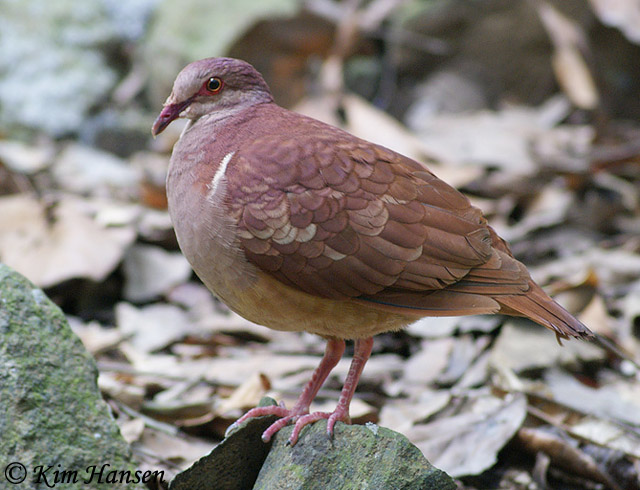
ID Keys: Rufous-colored overall, darker upperparts and lighter
underparts, reddish bill with darker tip, reddish legs. Female
similar, but duller.
The
Ruddy Quail-Dove is a widespread species in the tropical Americas, with a
distribution that covers much of northern South America, Central America,
the Caribbean, and parts of Mexico. In the United States, they are
only very rare vagrants, with a handful of sightings in extreme southern
Texas and southern Florida. They can be difficult birds to observe, as
they prefer to forage and nest in forest undergrowth, and will typically run
when disturbed rather than flush and fly into view.
Habitat
Found in the undergrowth of tropical woodlands and forests, as well as in second-growth forest.
Diet
Feeds on fruits and berries, as well as seeds, and sometimes small invertebrates.
Behavior
Most foraging is done by walking along the forest floor, in search of fallen fruit and other food items.
Nesting
The nest of a Ruddy Quail-Dove is a shallow bowl of twigs, covered in leaves. It is placed relatively low to the ground, typically on a tree stump, a fallen tree, or a low branch. The female lays two eggs, with the male incubating the eggs by day, and the female incubating the eggs at night. When the eggs hatch, both parents help feed and tend to the young. The young leave the nest after about 2 weeks.
Song
The song of a Ruddy Quail-Dove is a long, moaning coo, typically descending in pitch towards the end.
Migration
Considered a permanent resident throughout its normal range.
Interactive eBird Map
Click here to access an interactive eBird map of Ruddy Quail Dove sightings
Similar Species
Key West Quail-Dove, White-tipped Dove
Conservation Status
Populations have been in decline in recent decades. However, they are still found over a wide geographic area and are common in some areas. The IUCN lists the Ruddy Quail-Dove as a species of "Least Concern" .
Photo Information
Photo taken by Kim Hansen - Photo licensed under Creative Commons Attribution ShareAlike 2.0 Generic License.