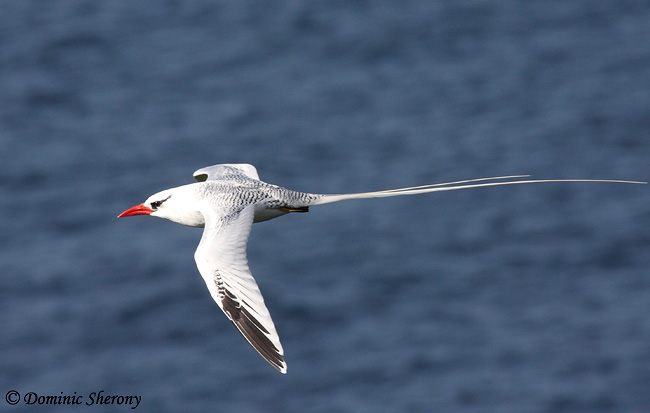
ID Keys: White overall, dark barring on back and rump, black primary
coverts, reddish bill, very long tail (adults)
The
Red-billed Tropicbird is the largest of the three tropicbird species. The
most obvious identification key for differentiating from the other
tropicbird species is the dark barring on their backs and rumps, markings
that are also there on juvenile birds of the other tropicbird species, but
are only retained by adult Red-billed Tropicbirds. They breed in scattered
islands in the tropical warm waters of the Indian Ocean, eastern Pacific
Ocean, and Atlantic Ocean. In North America, they are most often found
as vagrants along the eastern and Gulf Coasts, likely representing
dispersing birds from Caribbean breeding locations. They are the only
tropicbird species that is typically seen off the west coast of the United
States, and there they are only very rare vagrants, with most sightings off
the coast of southern California. Birds found here are likely
dispersing from breeding locations off the Pacific coast of Mexico.
Habitat
Found on tropical islands when breeding, preferring to use islands with rocky cliffs or other rocky areas for nesting and where taking flight is easy.
Diet
Feeds mostly on fish and squid, and occasionally other small marine creatures.
Behavior
Feeds by flying over the water's surface, and plunging down to grab prey when prey is spotted. They will also sometimes skim the water's surface and grab prey while in flight.
Nesting
Doesn't build a nest, but lays its single egg directly on the ground, on a rocky cliff ledge, or in a rocky crevice. Both parents will incubate the eggs, and upon hatching, both male and female help to feed and raise the young.
Song
Usually silent while at sea. On the breeding grounds, they have a harsh screeching call while displaying.
Migration
There is no regular migration, but the species has wandered widely outside of the breeding season, with sightings as far north as Canada or even Great Britain. However, most birds, especially adults, do seem to stay relatively close to breeding grounds at all seasons.
Interactive eBird Map
Click here to access an interactive eBird map of Red-billed Tropicbird sightings
Similar Species
In the North American part of its range, most likely to be confused with the White-tailed Tropicbird , and Red-tailed Tropicbird.
Conservation Status
Populations of the Red-billed Tropicbird are lower than other tropicbirds that have been sighted in the U.S., and their breeding range is smaller. There are also indications that populations are declining, and total global populations is likely less than 30,000 individuals. However, at this time, populations appear to be stable on some key breeding grounds, and the IUCN lists the Red-billed Tropicbird as a species of "Least Concern ".
Photo Information
Photo taken by Dominic Sherony - Photo licensed under Creative Commons Attribution ShareAlike 2.0 Generic License