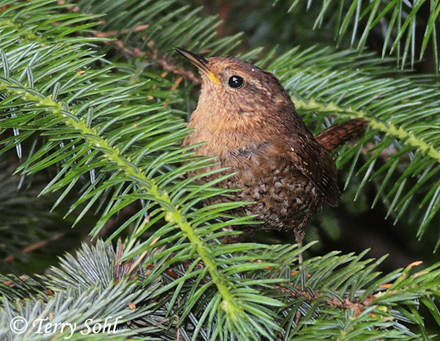
Prior to 2010, "Troglodytes troglodytes", the "Winter Wren", was considered one species. However, research revealed a genetic split between the wrens found in the western North America, eastern North America, and Eurasia. They were split into three distinct species in 2010, with the two North American populations named Pacific Wren and Winter Wren. The Pacific Wren is found in the humid forests of the Pacific Northwest, while the Winter Wren is found in eastern North America. Research indicates a genetic split between the two species going back at least 4 million years, and evidently the two populations do not commonly interbreed. They are distinctly separated by geography, and South Dakota is one area where both the Pacific and Winter Wrens may be seen, with Pacific Wrens found in the Black Hills in small numbers, while those birds found in the eastern part of the state are likely Winter Wrens.
Both birds are fond of dense forest undergrowth, often staying out of sight as they forage along the ground through thickets and fallen logs. While often difficult to spot, during breeding season the males will sometimes flit up to higher perches to sing extremely long complex songs, lasting 6-8 seconds or more and consisting of over a hundred separate notes. In addition to genetic differences and differences in range, the males' songs also are distinctly different between the two populations.
Habitat
During the summer breeding season, they are primarily found in moist conifer forests with a dense understory, often near water. They winter in similar forest habitats with dense understories, although they will use deciduous and mixed forests as well as conifer forests.Diet
The Pacific Wren feeds primarily on insects, spiders, beetles, caterpillars, flies, ants, and other small invertebrates. It forages close to the ground among moss-covered logs, root tangles, fallen branches, and dense forest vegetation, probing into crevices and sheltered spaces for prey.Behavior
The Pacific Wren is a secretive, energetic bird that spends much of its time near the ground exploring moss-covered logs, root tangles, fallen trees, and dense vegetation in conifer forests. It frequently flicks its short tail upward and slips through narrow crevices while searching for insects and spiders. Despite its tiny size, males vigorously defend territories and may sing almost continuously during the breeding season.Breeding
The Pacific Wren nests in cavities, root masses, mossy banks, rock crevices, fallen logs, and other sheltered sites within dense coniferous forests. The nest is a domed structure made of moss, twigs, bark, and plant fibers with a side entrance, often hidden among forest debris or vegetation. Typical clutches contain 5–7 eggs, and the female performs most of the incubation while both parents help feed the nestlings.Song
The Pacific Wren has an astonishingly loud and complex song for its size, consisting of a rapid torrent of trills, whistles, buzzes, and musical phrases delivered almost continuously. The song is often even longer and more intricate than that of the closely related Winter Wren. Calls include sharp chips, scolding notes, and dry chatter sounds given from dense forest cover.Migration
The Pacific Wren breeds in moist coniferous forests from coastal Alaska south through the Pacific Northwest and parts of the Rocky Mountains. Many populations are short-distance migrants, moving from higher elevations and northern breeding areas to lower-elevation forests, coastal habitats, and milder regions during winter. Compared to many songbirds, Pacific Wrens generally remain within western North America and do not undertake long-distance migrations.Interactive eBird Maps:
Click here to access an interactive eBird map for Pacific Wren sightings .
