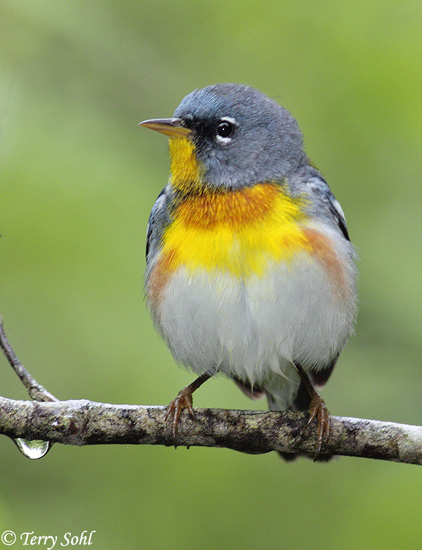
ID Keys: Blueish-gray upperparts, light underparts with yellow on
throat and upper chest, white wing-bars, broken white eye-ring.
The Northern Parula is another bird species which is often
easier to hear than to see, as they prefer to nest in areas with dense hanging
Spanish Moss or other lichens. The task is made more difficult because of their
tendency to forage in dense treetop foliage. Normally a bird of the
eastern part of the United States, strays often make it all the way to the West
Coast during migration.
Habitat
Prefers to nest in humid coniferous and deciduous forests, especially those that have an abundance of Spanish Moss or other tree lichens or are in and around swamps, rivers, and lakes. They can be found in nearly any kind of forest and woodland habitat during migration and in winter.
Diet
The Northern Parula feeds mainly on small insects and spiders gathered from foliage, bark, and hanging vegetation in trees. Its diet includes caterpillars, flies, beetles, moth larvae, and other tiny arthropods, with small berries occasionally eaten during migration and fall.
Behavior
The Northern Parula is an active canopy forager that moves quickly through leaves and hanging vegetation while searching for insects. It frequently joins mixed-species warbler flocks during migration and often gives soft chip notes while feeding high in trees.
Breeding
Non-breeder in South Dakota. In range, the Northern Parula typically nests in hanging clumps of moss, lichens, or other vegetation growing in trees, especially near water in moist forests. The female builds a small cup-shaped nest concealed within the vegetation using grasses, bark fibers, and soft plant material. Most clutches contain 3–5 eggs, and both parents help feed the nestlings after hatching.
Song
The Northern Parula sings a rising buzzy trill that ends in a sharp higher note, often described as a quick accelerating zee-up, zee-up, zeeeeee. Calls include soft chips and thin tseep notes commonly heard while the bird forages high in trees.
Migration
The Northern Parula migrates between breeding areas in eastern North America and wintering grounds in Florida, the Caribbean, Mexico, Central America, and parts of northern South America. During migration it frequents woodlands, riparian corridors, parks, and shrubby habitats where it forages actively in tree canopies and understory vegetation.
The Northern Parula is a small bluish-gray warbler with a yellow throat and chest, bold white wingbars, and a distinctive broken white eye ring. It is sometimes confused with the Tennessee Warbler, but Tennessee Warblers lack wingbars and show a plainer face with greener upperparts. Nashville Warbler also lacks the strong wingbars and bluish coloration of the Northern Parula and usually shows a complete white eye ring.
Conservation Status
The Northern Parula is generally considered a species of low conservation concern, with populations stable or increasing in many parts of its range. However, loss of mature forest habitat, air pollution affecting lichen growth, and fragmentation of riparian woodlands can negatively impact some breeding populations. The IUCN considers the Northern Parula to be a speciesof "Least Concern".
Photo Information
Photo taken on May 24th, 2012 near Acadia National park in Maine - Terry Sohl