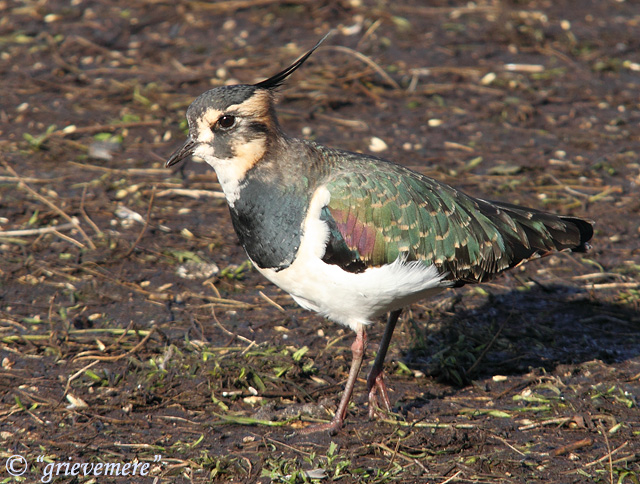
ID Keys: Obvious large crest, black breast, greenish back, white
underparts, white and black facial pattern in breeding plumage
(cream colored face on non-breeders)
The
Northern Lapwing is a species common in Europe and Asia, but vagrants have
been found a number of times along the east coast of the United States and
Canada. Winter storms in the Atlantic have occasionally been
associated with small influxes of Northern Lapwings in North America.
In the fall of 2012, the large and destructive Hurricane Sandy was followed
by many sightings of Northern Lapwings in the northeastern United States and
southeastern Canada.
Habitat
Northern Lapwings are a "shorebird" that is more often found in open agricultural fields, short grasslands, or mudflats.
Diet
Feeds on insects, worms, spiders, and other small invertebrates.
Behavior
Forages by walking along the ground in search of invertebrates. They are usually very gregarious during migration and in winter, and can be found in large foraging flocks. They will feed both during the day and night, often feeding at night for worms and other invertebrates that are more easily obtained at that time.
Nesting
The nest is a simple scrape on the ground, lined with various bits of vegetative material. The female lays between 3 and 5 eggs, and both parents help to incubate them. After the eggs hatch, both parents help to raise the young.
Song
Calls include a series of high thin whistles, or a crisp, short " pee-wit ". The species is sometimes locally known as a Peewit.
Migration
While Northern Lapwings are semi-permanent residents in parts of their normal Eurasian range, most birds are migratory, breeding in Europe and northern Asia, with wintering locations including southern Europe, northern Africa, the Middle East, and southern and southeast Asia.
Interactive eBird Map
Click here to access an interactive eBird map of Northern Lapwing sightings
Similar Species
Distinctive if seen well.
Conservation Status
While populations may be decreasing, Northern Lapwings are still found over a large geographic region and are common in some parts of their range. The IUCN lists the Northern Lapwing as a species of "Least Concern".
Photo Information
Photo taken by " grievemere " - November 9th, 2009 - Lancashire, England, Great Britain - Photo licensed under Creative Commons Attribution NonCommercial ShareAlike 2.0 Generic License.