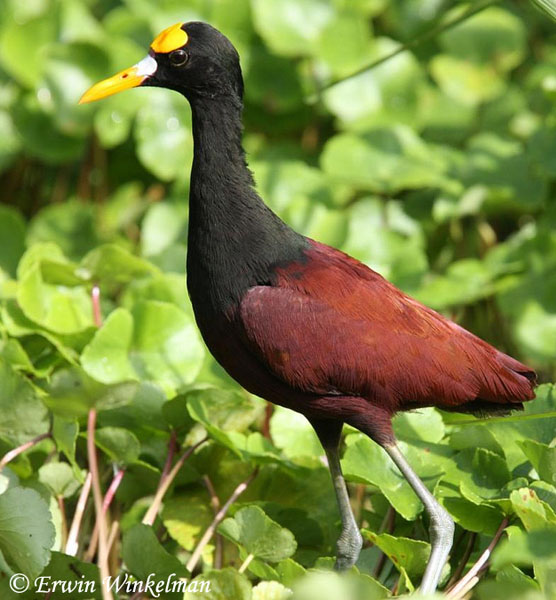
ID Keys: Bright yellow bill and forehead "shield", black head and
neck, rich rusty body, EXTREMELY long toes
The
Northern Jacana is a unique tropical shorebird that is primarily found in
Mexico, Central America, and the Carribbean. However, on occasion,
vagrants have shown up in the United States, most often in southern Texas.
They are very well adapted to clambering on top of wetland vegetation, with
freakishly long toes that are equal in size to roughly half of the bird's
body length.
Habitat
Found in a variety of freshwater habitats. The typical characteristics are shallow water with extensive wetland vegetation, especially floating vegetation such as lily pads.
Diet
Feeds mostly on insects, but will also occasionally feed on small fish, and possibly tiny mollusks and snails.
Behavior
Forages by walking on top of wetland vegetation, using its incredibly long toes to distribute its weight and stay on the top of the vegetation mass. They will also sometimes forage in very shallow water or on land next to the shoreline.
Nesting
The nest of a Northern Jacana is a cup made of grasses, wetland vegetation, and other vegetative material, placed on top of or within wetland vegetation in shallow water. The female builds the nest, but it is the male who incubates the eggs. Upon hatching, it is the male that typically tends to and feeds the young, although occasionally the female will also help rear the young.
Song
The Northern Jacana is typically only heard in flight, where it may give a abrasive squawking call.
Migration
They are considered permanent residents throughout their range. However, some dispersion must occur, as they do colonize newly formed habitat when wetter weather patterns result in increased wetland and water extent. Movements into southern Texas most often occur after a series of wet years.
Interactive eBird Map
Click here to access interactive eBird map of Northern Jacana sightings
Similar Species
Unlikely to be confused with another species in North America, if seen well.
Conservation Status
The Northern Jacana remains common throughout much of its range, despite local declines in areas where habitat has been lost. The IUCN lists the Northern Jacana as a species of "Least Concern".
Photo Information
Photo taken by Erwin Winkelman - Licensed under Creative Commons Attribution-NoDerivs 2.0 Generic License.