ID Keys: Dark plumage above and below, stubby dark bill, paler
"chin" area, dark "M" pattern on upper wings seen in good light
The
Murphy's Petrel is relatively "new" to science, having only first been
described as a species in 1949. They breed on a few low-lying islands
in the south Pacific, where their breeding success has plummeted in the last
several decades as the introduction of rats and other invasive species had
led to direct predation of eggs and young birds. Murphy's Petrels were
unknown to approach North America until pelagic birding tours far off the
west coast of the United States started occasionally finding them in the
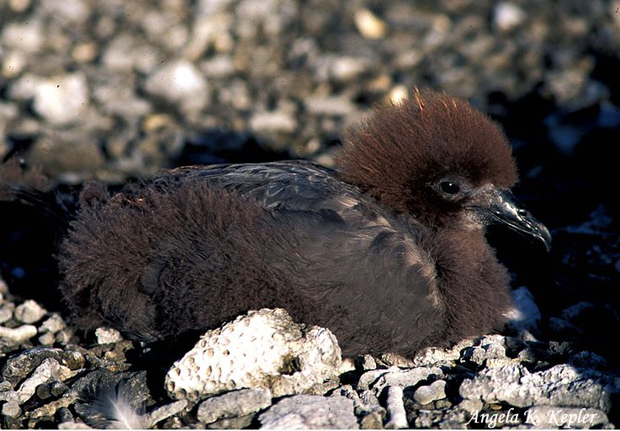
spring. The photo to the right shows a young fledgling. Adult
birds are known for their dark overall plumage, an "M" shaped dark marking
across their upper wings (visible in flight), and a stubby dark bill.
Habitat
Breeds on small rocky islands in the
south Pacific. Pelagic at other seasons, typically on the open ocean
very far from land.
Diet
Feeds on fish, squid, small crustaceans, and
other small marine creatures.
Behavior
Mostly feeds by flying over the water's
surface, dipping down and skimming prey from the surface or just below the
surface while maintaining flight.
Nesting
The nest of a Murphy's Petrel is a
shallow scrape, often at the base of a small tree or rock, or sometimes in a
cavity on a cliff or rocky area. They lay a single egg that is
incubated by both the male and female. After the egg hatches, both
parents tend to the young and help feed it.
Song
Usually silent at sea away from breeding
colonies. On breeding colonies, has multiple hooting and crying calls.
Migration
Breeds in a small number of island
locatiosn in the south Pacific. Non-breeding birds disperse widely in
the Pacific basin, with breeding areas completely abandoned outside of the
breeding season. Non-breeding birds are found as far north as the
Hawaiian Islands, and as far east as off the west coast of the United
States.
In the North American portion of their range, possibly confused with other
dark bodied Petrel and Shearwater species. The overall dark plumage, both on
the bird's upperparts and underparts, coupled with the very short stubby
bill, help to differentiate the species.
Conservation Status
Breeding locations have been
disturbed by anthropogenic activity in the past which has greatly reduced
breeding populations. The introduction of rats to nesting islands has
decimated some breeding populations, while development and human use of
other islands has similarly reduced breeding success. Populations
continue to decrease, and
the
IUCN lists the Murphy's Petrel as "Near Threatened".
Photo Information
Photo
of fledgling Murphy's Petrel taken by Angela Kepler on Oeno Island -
Released into the Public Domain.