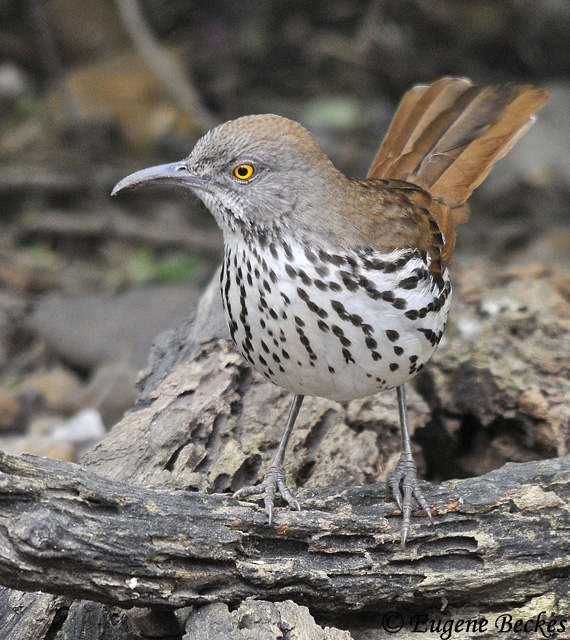
ID Keys: Dark brown upperparts, white below with black streaks, gray
face
The
Long-billed Thrasher is a close relative of the
Brown Thrasher. While the Brown
Thrasher has a widespread range across much of the United States and
southern Canada, the Long-billed Thrasher only enters the U.S. in southern
Texas, where they can be fairly common. Their range does overlap with
the Brown Thrasher, particularly during winter months when migrating Brown
Thrashers may enter areas with Long-billed Thrashers. The Long-billed
Thrasher can be distinguished from Brown Thrashers by their duller, less
"rich" plumage on the upperparts, their gray face, and their very white
underparts with black streaks. Brown Thrashers have a richer rufous
color above, a bit of a buffy tinge to their underparts, and streaks that
range from rufous to very dark brown.
Habitat
Found in shrubby areas and in thick
woodland undergrowth, often near water sources.
Diet
Feeds on insects and spiders, as well as
some feeding on seeds, fruits, berries, and small vertebrates such as small
frogs and lizards.
Behavior
Mostly feeds on the ground, walking
along in search of insects and using its bill to overturn leaf-litter and
rocks. They will also use their bill to make shallow probes in the
ground.
Nesting
The nest is a bulky cup of sticks and
twigs, lined with softer vegetative material such as grasses or roots.
The nest is placed in dense shrubs or cacti, placed between 3 and 10 feet
from the ground. The female usually lays 3 or 4 eggs, and both parents
help to incubate them. After the eggs hatch, both parents help to feed
the nestlings. The young leave the nest after about 2 weeks.
Long-billed Thrashers often will raise more than one brood per season.
Song
The song is a series of rich musical phrases
Migration
Considered a permanent resident, but
there have been a handful of strays that have been found well outside their
normal range.