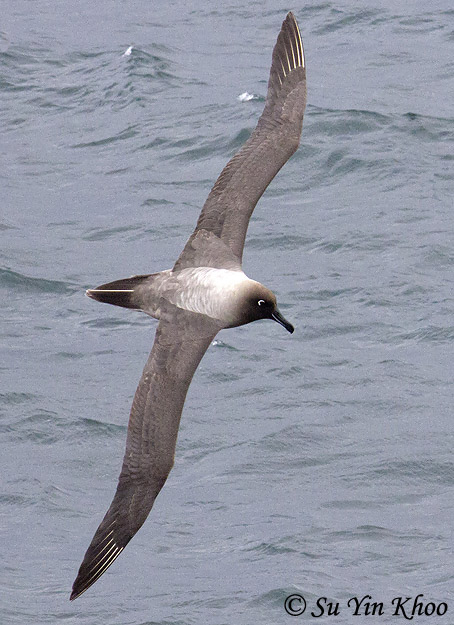
ID Keys: Sooty-gray color overall, darker head, lighter back from
nape to mid-back, white crescent around eye
The
Light-mantled Albatross (also known as the Light-mantled Sooty Albatross) is
a beautifully plumaged, small albatross from the southern oceans. They breed
on sub-arctic islands in multiple locations across the Atlantic, Pacific,
and Indian Oceans. Outside of breeding, individual birds range widely
across the southern oceans, but typically remain over cold waters, from
about 35 degrees south latitude all the way to the edge of the Antarctic
pack ice. The lone record from North America was a sighting off the
coast of California in 1994, a completely unexpected occurrence given that
the species rarely wanders far from the cold southern oceans.
As with many other Albatross species, they are considered an at-risk
species. Long-line fishing takes a toll on birds that are
accidently caught (and drowned) as bycatch. Predators such as rats
and cats that have been accidentally introduced to their breeding
islands also negatively impact populations as breeding success is
greatly reduced.
Habitat
Found on a number of islands in the far
southern oceans when breeding, including islands off the coast of southern
Australia and New Zealand, South America, and South Africa. Nesting areas
are typically rocky cliffs or other steep slopes. Non-breeding birds
are found throughout the southern oceans, typically far out at sea, from the
edge of the Antarctic pack ice to 35-degrees south latitude.
Diet
Feeds on fish, squid, krill, and sometimes
carrion.
Behavior
Feeds by swimming on the ocean's surface
and reaching down to grab food items. Will also make shallow dives
under the water in pursuit of prey.
Nesting
Breeding is usually done in loose
colonies. The nest is a mound of moss, mud, and grasses. A
single egg is laid, and both the parents help incubate it during a long
incubation period of just over 2 months. Both parents help to raise
and feed the young after hatching, and sometimes both parents are out
foraging while the chick remains alone in the nest. Nesting pairs are
faithful and may return to the same nest site to breed together for years,
renewing their bonds each season upon returning to the breeding site.
Nesting occurs every 2 years.
Song
Has a harsh, trumpet-like call, most often
heard around breeding colonies.
Migration
Breeds on a number of sub-arctic
islands in the far southern Indian Ocean, Atlantic Ocean, and Pacific Ocean
near New Zealand. After leaving the breeding grounds, they may found
nearly anywhere in the cold southern oceans.