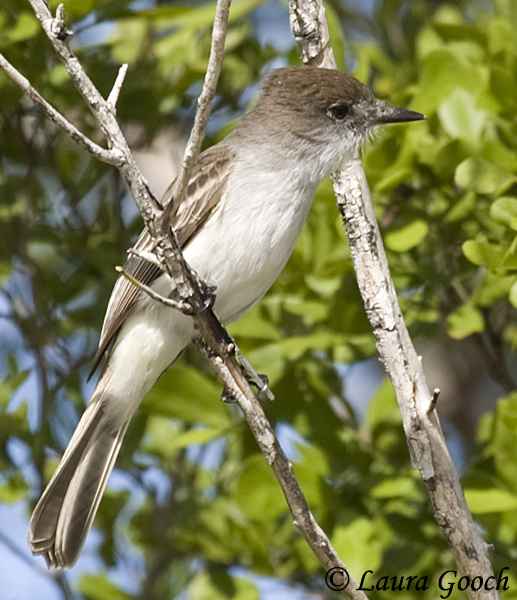
ID Keys: Grayish upperparts, pale underparts with slight or no
yellow, dark tail with limited rufous color
The
La Sagra's Flycatcher is native to Cuba, the Bahamas, and other islands in
the western Caribbean. They were unknown in the United States until a
bird was found in central Alabama in the 1980s. Since then, the
species has been spotted a number of times in southern Florida. They
are similar in structure and general appearance to the confusing group of
other "Myiarchus" flycatchers (Brown-crested
Flycatcher, Ash-throated
Flycatcher, Great Crested
Flycatcher, Dusky-capped
Flycatcher, and Nutting's
Flycatcher). However, most of those species, with the exception of
the Great Crested Flycatcher, are found in western North America. The
La Sagra's Flycatcher can also be distinguished from other Myiarchus
flycatchers by the light underparts that either only have a very slight wash
of yellow, or lack yellow altogether.
Habitat
Found in subtropical and tropical
forested habitats of the western Caribbean.
Diet
Feeds on insects and spiders, but will also
sometimes feed on berries, small fruits, or seeds.
Behavior
Foraging is done by observing from a
perch, and flying out to hover and glean insects from foliage, or by
capturing insects in mid-air.
Nesting
The nest of a La Sagra's Flycatcher is
built in a cavity in a tree, either an old woodpecker hole or a natural
cavity. The nesting cavity is lined with weed stems grasses, sticks,
and animal hair. The female usually lays 3 or 4 eggs, and she alone
incubates them. When the eggs hatch, both parents help to feed and
raise the young.
Song
The call of a La Sagra's Flycatcher is a
squeaky weeEENK that rises is pitch, and is often given in pairs.
Migration
Considered a permanent resident
throughout their normal range in the western Caribbean.
Similar in appearance to the other Myiarchus flycatchers, but is generally
"plainer", with limited or no yellow on the underparts, and a tail that
lacks the rich rufous colors of some of the Myiarchus flycatchers.
Most similar in appearance to the
Ash-throated Flycatcher, a species of the western United States and
Mexico, but, like the La Sagra's, a species that has occasionally wandered
to parts of the southeastern United States.