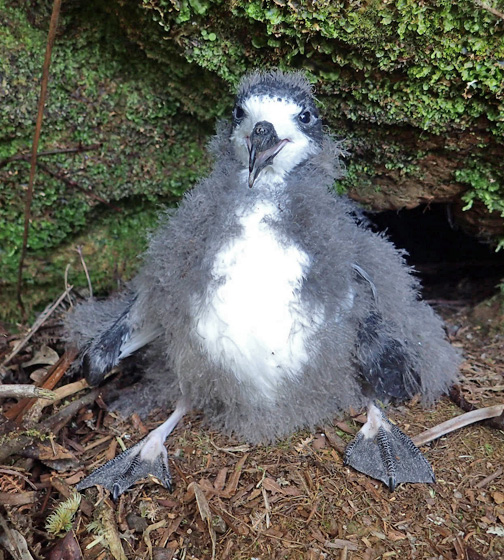
The Hawaiian Petrel and the Galapagos Petrel were once considered one species, the "Dark-rumped Petrel". They were once abundant across the Hawaiian Islands, but development and the introduction of non-native animals such as cats, mongoose, rats, pigs, and goats have decimated breeding populations in many locations. Breeding now only occurs at five high-elevation locations, with continued threats at these locations. In North America they are known from a number of sightings off the west coast of the United States.
Habitat
Breeding areas on Mauna Loa, Mauna Kea, and Maui are on very sparsely vegetated lava fields, using cavities and crevices for nesting. In other locations, breeding may occur in areas of low dense shrubs and ferns, or at the base of other protective woody vegetation. They are pelagic outside of the breeding season, ranging across parts of the north Pacific.
Diet
The Hawaiian Petrel feeds primarily on squid, small fish, and crustaceans captured at or just below the ocean surface.
Behavior
On their breeding grounds they are highly nocturnal, only leaving nesting locations at night to forage. Foraging is done by skimming prey items from the water's surface, either by swimming on the ocean's surface or by gathering food while in flight. Hawaiian Petrels do not dive under the surface of the water after prey.
Nesting
The breeding season is long, beginning in March or April, with a chick not fledging until November or December. The nest depends upon location. In rocky lava fields, the nest is in a deep crevice, while elsewhere it may be a constructed burrow, or amidst thick ground vegetation. A single egg is laid, with both parents helping incubate it for approximately 54 days. Once the egg hatches, the chick is largely alone at the nesting site as the parents each go on extended foraging trips. Each parent returns periodically to feed the chick regurgitated fish and squid.
Song
The species is known as a 'ua'a locally, in reference to its haunting calls that are heard at night around breeding locations. They are generally silent away from breeding colonies.
Migration
Hawaiian Petrels have complicated movement patterns. During breeding season, from incubation until a week or two after the young hatch, they stay around nesting sites on the Hawaiian Islands. Once the chick is a bit older both parents make long foraging trips, with research showing foraging as far as the Aleutians and eastern Pacific. Once the chicks fledge, they disperse across much of the north Pacific and are found as far north as 50 degree north latitude.
Interactive eBird map
Click here to access an interactive eBird map of Hawaiian Petrel sightings
Similar Species
Once considered conspecific with the Galapagos Petrel, they are very similar in appearance, but separated by range. Sargasso Shearwater is similar but smaller. They may also be confused with Cook's Petrel , but that too is a smaller species.
Conservation Status
The IUCN lists the Hawaiian Petrel as a "endangered" species. They are only known to breed on five locations on the Hawaiian Islands. Numbers are undoubtedly far below historical levels. Introduced predators on the Hawaiian Islands have eliminated some former breeding locations and continue to threaten existing locations. Urbanization encroaches on some breeding locations, while powerlines and an attraction to nights at light also have been implicated in the species' decline. Efforts to control invasive species have resulted in some encouraging increases in number at at least one breeding location.
Further Information
Photo Information
Photo taken November 2nd, 2015 on Kaua'i in Hawaii- Photo by U.S. Fish and Wildlife - Photo licensed under Creative Commons Attribution 2.0 Generic License
