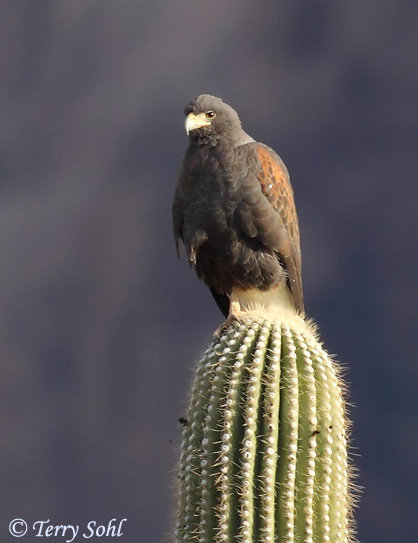
The Harris's Hawk is a raptor of dry habitats in the southwestern United States. Their range also extends southward through much of Mexico and into South America. They are unusual compared to the similar Buteo family of hawks in that they are relatively social. Small groups of 2 or 3 (occasionally up to 8) Harris Hawks will roost and hunt together, with individual birds cooperatively chasing prey, with one bird flushing the prey and another capturing it. When prey is captured, it is often consumed by multiple birds in the social group. They are equally unusual in their nesting habits. One female will often raise young in conjunction with two males, with all three adult birds helping to incubate the eggs and raise the young.
Habitat
Harris's Hawks are found in a variety of dry, open habitat. In the Sonoran Desert they are found in saguaro cactus deserts, while in New Mexico and Texas, they are found in mesquite woodlands and riparian zones.
Diet
Feeds on many different small animals, including rodents and other small mammals, birds, lizards, snakes, and large insects.
Behavior
More gregarious than many hawks, with two or more Harris's Hawks often roosting together and hunting together. Hunting is most often done by flying relatively close to the ground and rapidly pursuing prey if spotted. When hunting cooperatively, Harris's Hawks will often share larger prey items that are caught.
Nesting
The nest of a Harris's Hawk is a bulky platform of sticks, usually lined with twigs and grasses. The nest is typically in the crook of a saguaro cactus or in a small tree. Both males and females will help to build the nest, incubate the eggs, and help to raise the young.
Song
The Harris's Hawk gives loud, harsh, rasping screams and repeated kee-kee-kee calls, especially when family groups are in contact or alarmed. Around the nest or during social interactions it also produces chattering and whining notes that reflect its unusually cooperative behavior for a hawk..
Migration
Considered a permanent resident throughout its range, although some birds make short distance movements in response to feeding opportunities.
Interactive eBird Map
Click here to access an interactive eBird map of Harris's Hawk sightings
Similar Species
Common Black Hawk, Zone-tailed Hawk, Swainson's Hawk in their normal range. The Harris's Hawk is a dark brown hawk with rich chestnut shoulders and thighs, bold white at the base and tip of the tail, and conspicuous yellow facial skin, giving it a very distinctive tricolored look. Common Black Hawk is bulkier and almost uniformly blackish, lacking the chestnut patches and showing only a single broad white tail band. Zone-tailed Hawk is longer-winged and slimmer in flight, appearing almost all black with pale tail barring and often soaring vulture-like, while Swainson's Hawk is much paler overall in most plumages, with lighter underparts, a contrasting dark bib, and none of the Harris’s Hawk’s bright chestnut-and-white tail pattern.
Conservation Status
Numbers have declined in recent decades in the United States portion of their range. However, globally there are currently no perceived major threats to Harris's Hawk populations, and the IUCN cites it as a species of "Least Concern" .
Further Information
- eBird - Harris's Hawk
- Audubon Field Guide - Harris's Hawk
- Cornell Lab of Ornithology - All About Birds: Harris's Hawk
Photo Information
December 10th, 2010 - Saguaro National Park, Arizona - Terry Sohl
