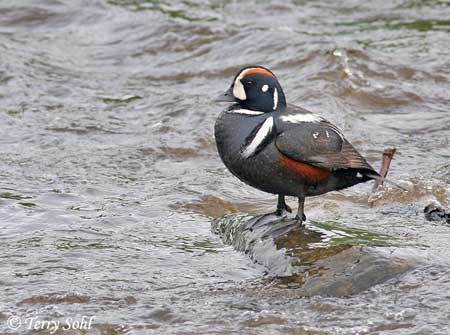
The Harlequin Duck is a small duck of fast streams and rivers in the summer, and pounding coastal waters in the winter. Studies on the species have shown that many adult birds have suffered broken bones in their past, obviously due to their preferred habitats. They are generally only short distance migrants from the summer breeding locations, and thus are only very rare visitors to the deep interior of the continent.
Habitat
The Harlequin Duck inhabits fast-flowing mountain streams, rivers, and cascades during the breeding season, especially in rugged forested or alpine landscapes. During migration and winter it occurs mainly along rocky coastlines, surf zones, offshore reefs, and protected marine waters where it feeds in turbulent ocean conditions.
Diet
The Harlequin Duck feeds primarily on aquatic insects, insect larvae, crustaceans, mollusks, and other invertebrates gathered by diving in streams and coastal waters. During winter, marine prey such as mussels, snails, crabs, and amphipods make up much of its diet.
Behavior
The Harlequin Duck is a strong swimmer and diver that thrives in turbulent water, often foraging in rapids, surf, and rocky coastal areas where few other ducks occur. It is frequently seen in small groups and uses swift dives to capture aquatic invertebrates from stream bottoms or among wave-washed rocks.
Breeding
Non-breeder in South Dakota. The Harlequin Duck nests on the ground near fast-flowing mountain streams, often concealed beneath shrubs, among rocks, or in dense vegetation. The female builds a shallow bowl lined with grasses, leaves, and soft down feathers, usually well hidden from predators. Typical clutches contain 5–8 eggs, and the female alone incubates the eggs and raises the ducklings after hatching.
Song
The Harlequin Duck is generally quiet, but females give a series of squeaky, rapid chatter notes and sharp quacks that carry well above rushing water. Males produce soft squeals, whistles, and thin high-pitched calls, especially during courtship and pair interactions.
Migration
Summers in Alaska, western Canada, and locally in the Northwest U.S., as well as locally in eastern Canada. Winters along the Pacific and Atlantic coastlines, generally from the northern U.S. and along Canada and Alaska.
Interactive eBird Map
Click here to access an interactive eBird map of Harlequin Duck sightings
Similar Species
The male is generally unmistakable, but the female is somewhat similar to a female Bufflehead. The Harlequin Duck differs from a female Bufflehead by its two distinctive white facial spots—one in front of the eye and another behind it—along with its smaller bill and more compact shape. Female Buffleheads show a single large white cheek patch, a larger rounded head, and a shorter-necked appearance. Harlequin Ducks also tend to occur in fast-flowing streams or rocky coastal waters, whereas Buffleheads are more commonly found on ponds, lakes, and sheltered bays.
Status
The Harlequin Duck is generally considered a species of low conservation concern overall, although some regional populations are small and vulnerable. Threats include oil spills, disturbance in coastal wintering areas, habitat degradation along mountain streams, and climate-related changes affecting aquatic food resources. Conservation efforts often focus on protecting breeding streams and important marine wintering habitats. The IUCN considers the Harlequin Duck to be a species of "least concern".
Further Information
- eBird - Harlequin Duck
- Audubon Field Guide - Harlequin Duck
- Cornell Lab of Ornithology - All About Birds: Harlequin Duck
Photo Information
June 22nd, 2006 - Kenai Peninsula in Alaska, near Soldatna - Terry Sohl
