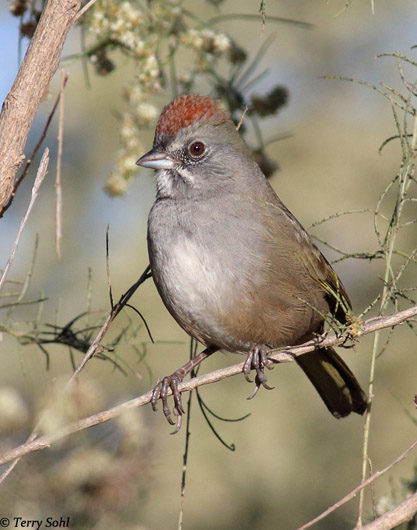
The Green-tailed Towhee is a bird of mountains of the West in summer, where they are often first noticed when strange catlike mewing is heard from dense shrubbery. Their behavior is very similar to other Towhees, in that they prefer to remain low in the vegetation and will often scratch at leaf-litter in an attempt to find food. They are only rare visitors to South Dakota, although stray migrants do show up as far east as the Atlantic Coast every fall.
Habitat
Found in a variety of semi-open habitats, primarily in the mountains of the West. Preferred habitats are areas of low dense shrubby cover with a few scattered taller trees. They are a species that can tolerate a human presence, and sometimes benefit by the low second-growth vegetation that grows after the clearing of a forest.
Diet
The Green-tailed Towhee feeds primarily on seeds, berries, and other plant material for much of the year. During the breeding season, it also consumes a variety of insects and spiders, including beetles, caterpillars, ants, and grasshoppers, which provide important protein for adults and nestlings.
Behavior
The Green-tailed Towhee is a secretive bird that spends much of its time foraging on the ground beneath dense shrubs. It searches for food by scratching vigorously through leaf litter with both feet, uncovering seeds and insects. During the breeding season, males sing from exposed perches to defend territories, while the species generally remains concealed within brushy habitats.
Breeding
The nest of a Green-tailed Towhee is a cup sticks, bark, and herbaceous plant stems, lined with finer grasses, hair, and small rootlets. The female alone builds the nest, placing it low in dense vegetation such as a shrub or small tree. She lays between 2 and 5 eggs, and she alone incubates them. The young hatch after 12-14 days, and fledge from the nest after another 12-14 days.
Song
A series of chip notes evolving into a trill. Click here to hear the song of a Green-tailed Towhee (audio courtesy of Lance A.M. Benner ). The typical call is an ascending mewing somewhat reminiscent of a Gray Catbird . Click here to hear the call of a Green-tailed Towhee (audio courtesy of Jeremy Minns ).
Migration
The Green-tailed Towhee is a migratory species that breeds in shrublands and mountain foothills of the western United States and southern Canada. It winters primarily in the southwestern United States and Mexico, where it occupies brushy habitats and woodland edges. Migration occurs mainly at night, with birds traveling between breeding and wintering grounds each spring and fall.
Interactive eBird Map
Click here to access an interactive eBird map of Green-tailed Towhee sightings
Similar Species
Olive Sparrow (only normally found in the Rio Grande Valley in the United States). The Green-tailed Towhee is larger and bulkier than the Olive Sparrow, with a gray head, bright rufous crown patch, white throat, and olive-green wings and tail. Olive Sparrows lack the rufous crown and bold white throat, instead showing a plainer face with subtle rusty crown stripes and more uniformly olive-brown coloration overall.
Bird Feeders
Will attend feeders for various seeds and grains.
Conservation Status
Numbers are generally stable, and they are found over a very wide geographic area. They've adapted fairly well to a human presence, and no serious threats to their populations are noted. The IUCN considers the Green-tailed Towhee to be a species of "least concern" .
Further Information
- eBird - Green-tailed Towhee
- Audubon Field Guide - Green-tailed Towhee
- Cornell Lab of Ornithology - All About Birds: Green-tailed Towhee
Photo Information
Photo taken on November 11th, 2015 - Tanque Verde Wash, Tucson, Arizona - Terry Sohl
