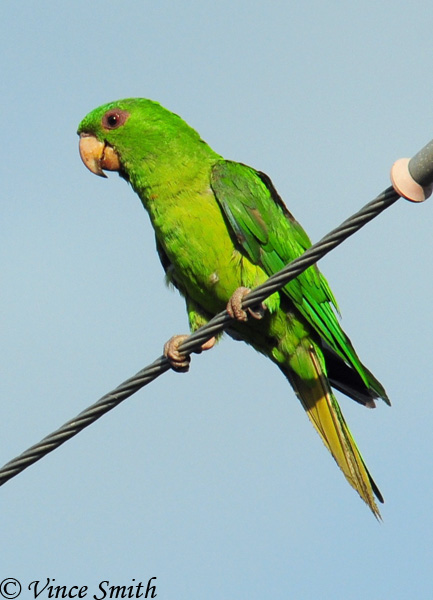
The Green Parakeet is a medium-sized parrot native to Mexico and northern Central America, where it inhabits forests, woodlands, scrub, agricultural areas, and urban parks. It is bright green overall with a long pointed tail and a loud, chattering voice that often reveals its presence before it is seen. The species feeds on seeds, fruits, berries, flowers, and cultivated crops and usually travels in noisy flocks. It nests in natural tree cavities, cliff crevices, and occasionally in man-made structures. In North America, the Green Parakeet is established as a localized resident in southern Texas, particularly in the Lower Rio Grande Valley, where natural populations occur and additional birds may have originated from escapes or releases. It is now a regular and familiar species in parts of southern Texas, especially around urban areas, parks, and neighborhoods with mature trees.
Habitat
The Green Parakeet inhabits forests, woodland edges, thorn scrub, riparian woodlands, agricultural areas, parks, and urban neighborhoods. It prefers habitats with mature trees that provide nesting cavities and abundant food sources. In the United States, it is most commonly found in the Lower Rio Grande Valley of Texas, where it readily occupies cities, suburbs, and nearby natural woodlands.
Diet
The Green Parakeet feeds on a wide variety of seeds, fruits, berries, nuts, flowers, buds, and cultivated crops. It forages in trees and shrubs, often in noisy flocks, and readily takes advantage of ornamental and fruiting plants in urban areas. The species also visits backyard feeders for seeds and other supplemental foods where available.
Behavior
The Green Parakeet is a highly social and noisy bird that usually travels and forages in pairs or flocks. It spends much of the day flying between feeding and roosting sites, communicating with loud calls while feeding on fruits, seeds, flowers, and buds. The species is agile in flight, strongly territorial around nesting cavities, and often gathers in large communal roosts outside the breeding season.
Nesting
The Green Parakeet nests in natural tree cavities, old woodpecker holes, cliff crevices, and occasionally cavities in buildings or other structures. Unlike many parrots, it does not build a nest but lays its eggs directly on the cavity floor or on a thin layer of wood chips. The female typically lays 3–5 white eggs, and both parents participate in caring for the young after they hatch.
Song
The Green Parakeet is a loud and highly vocal species, giving frequent harsh screeches, chatter, and rolling calls while flying and foraging. Flocks remain in constant contact through piercing kee-kee-kee notes that are easily heard over long distances. These vocalizations are used to maintain flock cohesion, defend territories, and communicate between mates and family groups.
Migration
The Green Parakeet is a nonmigratory species that remains within its home range throughout the year. Individuals may make short local movements between feeding, nesting, and communal roosting sites, but they do not undertake seasonal long-distance migrations. Established populations, including those in southern Texas, occupy the same general areas year-round.
Interactive eBird map
Click here to access an interactive eBird map of Green Parakeet sightings
Similar Species
Distinctive in rare US appearances, unlikely to be confused with another species.
Conservation Status
Populations of Green Parakeet are widespread in their native range, and they are common in many parts of that range. Overall populations do seem to be decreasing, but the declines are not at a level at which the species would be considered to be in peril. The IUCN lists the Green Parakeet as a species of "Least Concern".
Further Information
Photo Information
Photo by Vince Smith - Photo licensed under Creative Commons Attribution 2.0 Generic License
