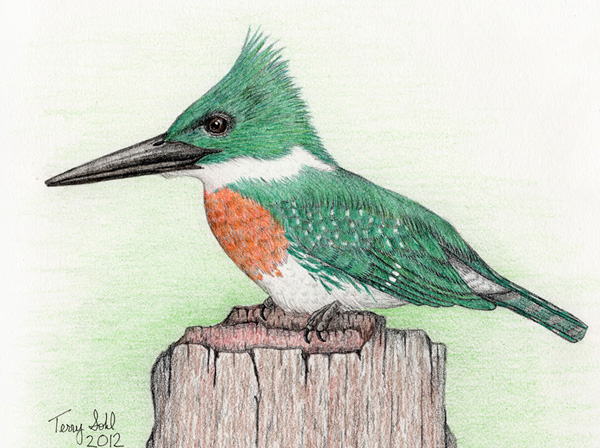
The Green Kingfisher is a small kingfisher of the tropical Americas, with a range that just extends in the U.S. in Texas and southern Arizona and New Mexico. They are often overlooked in areas where they are found, as they prefer to perch in thick vegetation along stream and river banks. Both the male and female share similar green plumage on the head and upperparts, but the male has a rusty-colored breast, while the female has green and white on the breast.
Habitat
The Green Kingfisher inhabits rivers, streams, ponds, marshes, lakes, mangrove swamps, and other freshwater or slow-moving aquatic habitats with abundant shoreline vegetation. It prefers areas with overhanging branches or exposed perches from which it can watch for fish and other aquatic prey. The species is commonly found in wooded riparian corridors and wetlands from the southern United States through Central and South America.
Diet
The Green Kingfisher feeds primarily on small fish, which it catches by diving headfirst from a perch into the water. It also consumes aquatic insects, crustaceans, tadpoles, frogs, and occasionally small reptiles.
Behavior
Green Kingfishers hunt by observing from a low perch, typically thick vegetation or a branch overhanging the water, and then plunging into the water when a small fish is spotted.
Nesting
The nest is a burrow built into the side of a river bank. Both the male and female help to excavate the nest burrow, which is typically 2 to 3 feet long, and ends in a larger nesting chamber. Both sexes help to incubate the eggs, and both parents help to raise the young.
Song
The Green Kingfisher is a solitary and highly territorial bird that spends much of its time perched quietly above the water watching for prey. It captures fish and other aquatic animals by making swift headfirst dives from low branches or other perches. After catching prey, it often returns to the same perch to beat the catch against a branch before swallowing it whole.
Migration
The Green Kingfisher is primarily a resident species throughout most of its range from the southern United States through Central and South America. Northern populations, including those breeding in the southern United States, may make short-distance seasonal movements southward after the breeding season. However, the species is not considered a long-distance migrant, and most individuals remain near suitable aquatic habitats year-round.
Interactive eBird Map
Click here to access an interactive eBird map of Green Kingfisher sightings
Similar Species
Much smaller size and different plumage makes it easy to identify from other kingfishers found in the U.S. In much of their tropical range they can be confused with the Amazon Kingfisher, as plumage is rather similar between the species. However, the Green Kingfisher is a much smaller species, weighing only about 1/3rd of the weight of an Amazon Kingfisher.
Conservation Status
The Green Kingfisher is classified as Least Concern by the International Union for Conservation of Nature because of its extensive range and large, stable population. It remains common throughout much of the Americas in suitable freshwater habitats. Although wetland loss and water pollution may affect some local populations, the species is not currently considered globally threatened.
Further Information
- eBird - Green Kingfisher
- Audubon Field Guide - Green Kingfisher
- Cornell Lab of Ornithology - All About Birds: Green Kingfisher
Image Information
Colored pencil drawing by Terry Sohl - March 2012
