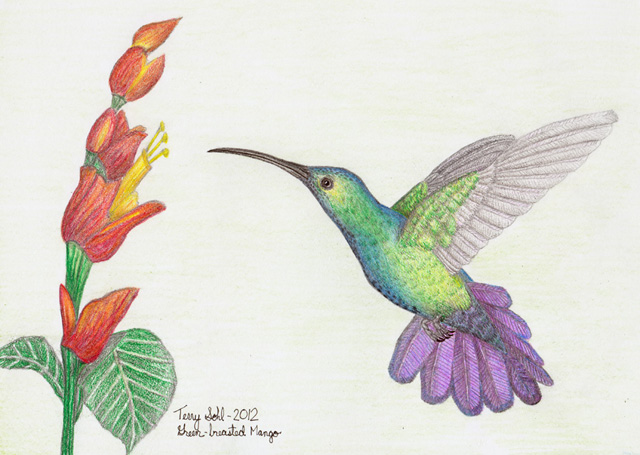
The Green-breasted Mango is a hummingbird of tropical America. They are normally found near the coasts of central and southern Mexico, and in Central America, but populations also occur in a few locations in northern South America. They were unknown in the United States until a bird was identified in south Texas in 1988. While still a very rare vagrant in the United States, they have been found a number of times since, mostly in south Texas and a few in Florida, but also with single sightings in North Carolina, Wisconsin, and Georgia. A female Green-breasted Mango, has an obvious central stripe on light-colored underparts. Males (depicted in the drawing on the right) have a brilliant green plumage on their underparts.
Habitat
The Green-breasted Mango inhabits tropical and subtropical forests, woodland edges, gardens, plantations, mangroves, and shrubby clearings. It is especially common in semi-open habitats with abundant flowering plants, where it feeds on nectar throughout the year. The species readily adapts to parks and residential gardens and is often one of the most frequently observed hummingbirds within its range.
Diet
The Green-breasted Mango feeds primarily on nectar from a wide variety of flowering trees, shrubs, and vines. It also consumes small insects and spiders, which provide essential protein, especially during the breeding season.
Behavior
The Green-breasted Mango is an active and often aggressive hummingbird that vigorously defends rich nectar sources from other hummingbirds and nectar-feeding birds. It spends much of the day hovering among flowers or perching between feeding bouts. Although typically solitary, it may gather temporarily where flowering plants are especially abundant.
Nesting
Males form loose breeding groups, displaying to passing females through high display flights. Females build the nest mostly from plant fibers, and camoflague the outside with bits of moss. The female also incubates the eggs and raises the young.
Song
The Green-breasted Mango gives a variety of sharp, high-pitched chips, squeaks, and rapid chattering calls during territorial disputes and courtship. Males vocalize frequently while defending flowering plants or displaying to females. Like many hummingbirds, its wing hum is also a noticeable sound during hovering and rapid flight.
Migration
Permanent populations are present in most of the eastern portion of its range, particularly in Central America and around the Yucatan peninsula. Birds that summer on the central Mexico Gulf coast are migratory, moving eastward for the winter, or south to the Pacific coast.
Interactive eBird Map
Click here to access an interactive eBird map of Green-breasted Mango sightings
Feeders
Will attend hummingbird feeders
Similar Species
Similar to other Mango species, particularly the Veraguan Mango and the Black-throated Mango. However, those species have not been seen in the ABA North America region.
Conservation Status
The Green-breasted Mango is classified as Least Concern by the International Union for Conservation of Nature because of its wide distribution from Mexico through Central America into northern South America and its large, stable population. The species readily adapts to gardens, plantations, and other human-modified habitats where flowering plants are abundant. Although localized habitat loss may affect some populations, it is not currently considered globally threatened.
Further Information
Image Information
Colored pencil drawing by Terry Sohl - 2012
