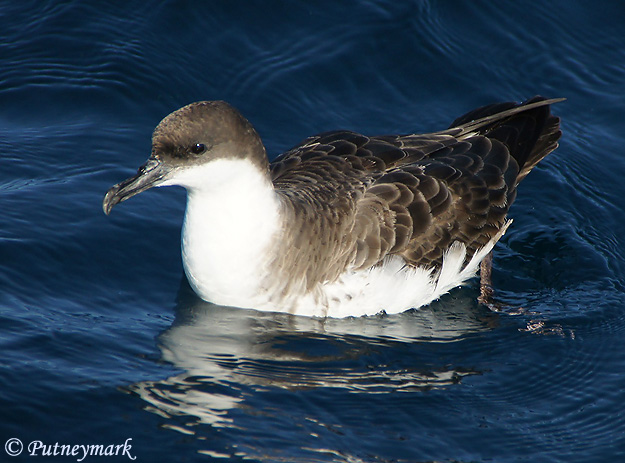
The Great Shearwater is one of the largest shearwaters found in the North Atlantic, where they are common during the summer months. Great Shearwaters are very long distance migrants, as they breed on a few islands in the South Atlantic, and then move to the North Atlantic during the Northern Hemisphere summer. They are a common sight around fishing boats in the North Atlantic, where they will follow boats to feed on discarded scraps and other waste.
Habitat
Nests on islands in the south Atlantic with soil soft enough to build burrows. Outside of the breeding season, they are found in colder offshore waters, typically not approaching the shoreline.
Diet
Feeds mostly on small fish and squid. Will also eat crustaceans and other small marine life, and will follow fishing boats to feed on fishing waste.
Behavior
May use a variety of foraging techniques, including plunge diving, swimming and plucking items from near the ocean's surface, or by swimming and diving underwater in pursuit of prey. Will feed at any time during the day or night, but most often forages during daylight hours.
Nesting
The Great Shearwater mostly nests in burrows in the ground, although they will also sometimes use crevices and gaps in rocky areas. The female lays a single egg, and both the male and female help to incubate it. After hatching, both parents help feed the nestling.
Song
Generally silent except when feeding, when groups of Great Shearwaters can be heard making a whinnying sound.
Migration
The Great Shearwater is a remarkable long-distance migrant that breeds on islands in the South Atlantic, primarily around Tristan da Cunha and Gough Island. After breeding, it migrates north through the Atlantic Ocean to spend the boreal summer feeding off the eastern coast of North America and across the North Atlantic. In autumn, it travels south again, completing a clockwise trans-Atlantic migration that covers tens of thousands of miles each year.
Interactive eBird Map
Click here to access an interactive eBird map of Great Shearwater sightings
Similar Species
Most similar in overall appearance to Cory's Shearwater . They can be readily differentiated by their bill, with the Cory's Shearwater having a thicker yellow bill, and the Greater Shearwater having a thin black bill. Plumage and overall shape are also distinct if seen well.
Conservation Status
The Great Shearwater is classified as Least Concern by the International Union for Conservation of Nature because of its large global population and extensive oceanic range. However, the species faces threats from bycatch in commercial fisheries, plastic pollution, oil spills, and climate-related changes affecting marine food supplies. Despite these pressures, it remains widespread and is not currently considered globally threatened.
Further Information
- eBird - Great Shearwater
- Audubon Field Guide - Great Shearwater
- Cornell Lab of Ornithology - All About Birds: Great Shearwater
Photo Information
Photo taken by "Putneymark" - Photo licensed under Creative Commons Attribution ShareAlike 2.0 Generic license .
