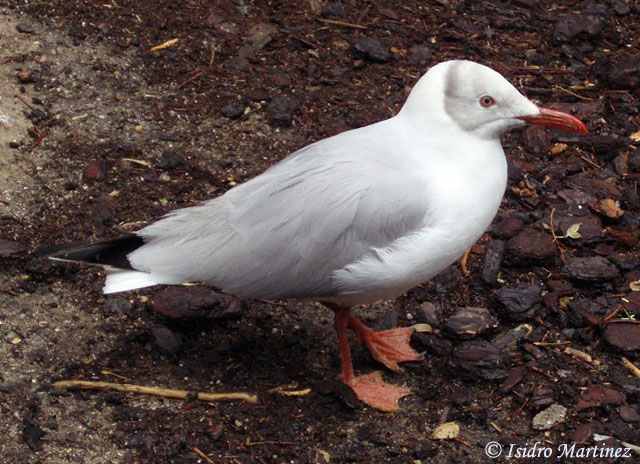
The Gray-hooded Gull is a medium-sized gull found primarily in South America and sub-Saharan Africa, where it inhabits both coastal and inland wetlands. It is recognized by its pale gray body, white underparts, red bill and legs, and the gray hood worn by adults during the breeding season. The species feeds on fish, aquatic invertebrates, insects, and a variety of other small prey, often foraging along shorelines, marshes, and agricultural fields. It breeds in colonies on islands, marshes, and lakeshores, where both parents share incubation and care of the chicks. In North America, the Gray-hooded Gull is an extremely rare vagrant, with only a handful of accepted records. They were unknown in North America until a sighting in Florida in 1998. In 2011, a bird found on Coney Island in New York City caused quite a commotion, with birders flocking from around the region to see the mega-rarity.
Habitat
Found around freshwater wetland habitats during the breeding season, as well as tropical and subtropical coastal areas. Found around a greater variety of aquatic habitats outside of the breeding season.
Diet
Omnivorous. Feeds heavily on fish when available, but will also feed on insects, mollusks, crustaceans, other invertebrates, eggs, fledgling birds, refuse, and carrion.
Behavior
Foraging technique depends on location and what food items are availble.
Nesting
In their native range, Gray-hooded Gulls are colonial nesters, with colonies in areas of wetland vegetation or on islands. The nest itself differs depending upon location. It may be just a simple scrape on the ground, or it may be a substantial structure built of grasses and wetland vegetation. The female lays 2 or 3 eggs.
Song
Loud around nesting colonies, with a crow-like "cawing" call.
Migration
Not truly migratory, as most birds stay relatively close to breeding locations. Some birds may disperse outside of breeding, however, but no regular or predictable migration is noted. African and South American populations evidently do not interact, but they are still considered the same species.
Interactive eBird map
Click here to access an interactive eBird map of Gray-hooded Gull sightings
Similar Species
Similar to the Brown-hooded Gull, a species not seen in North America. If seen well, the gray hood and other characteristics should be diagnostic in North America, should it occur again.
Conservation Status
The Gray-hooded Gull is classified as Least Concern by the International Union for Conservation of Nature because of its large geographic range and stable global population. It remains common across much of South America and sub-Saharan Africa, where it occupies a variety of coastal and inland wetland habitats. Although localized threats such as wetland degradation, pollution, and human disturbance may affect some breeding colonies, the species is not currently considered globally threatened.
Further Information
Photo Information
Photo taken by Isidro Martinez - Photo licensed under Creative Commons Attribution NonCommercial ShareAlike 2.0 Generic License.
