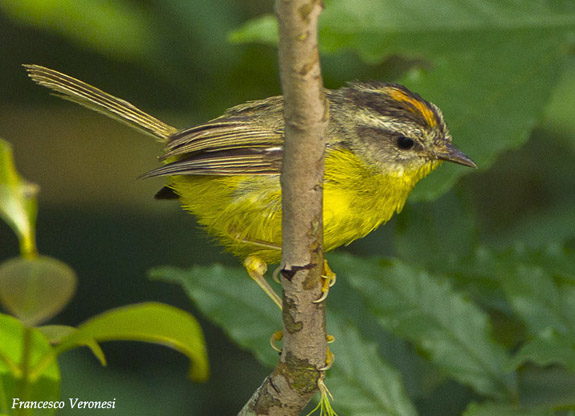
The Golden-crowned Warbler is a widespread species of warmer locations in both North and South America, extending from Mexico and Central America southward through Brazil. In the United States they are a vagrant, with a number of sightings in far southern Texas, and one in eastern New Mexico. There are a number of sub-species present throughout their range, with the possibility that birds currently classed as Golden-crowned Warblers may indeed comprise multiple individual species.
Habitat
Found in humid, tropical and sub-tropical forests, including mature forest, second-growth forest, and sometimes heavily managed lands such as coffee plantations or other tree plantations. They can also sometimes be found in thickets and undergrowth of more open woodlands, or in brush with nearby forest land.
Diet
The Golden-crowned Warbler feeds primarily on insects and other small arthropods, including caterpillars, beetles, ants, spiders, and flies. It actively forages in dense vegetation, gleaning prey from leaves, twigs, vines, and low branches. The species may also consume small berries and fruits on occasion, but animal prey makes up the majority of its diet.
Behavior
Very active foragers, Golden-crowned Warblers typically occurs in the forest understory. They are somewhat gregarious, often forming small loose foraging groups that may include other small insectivorous species.
Nesting
The nest of a Golden-crowned Warbler is a dome-shaped structure built on the ground, typically in a location that is semi-protected by a clump of vegetation, a stump, or other protective cover. The nest is built of grasses, roots, and other fibrous plant material. The female lays between 2 and 4 eggs, which she alone incubates. The eggs hatch after about 12 days.
Song
The song of a Golden-crowned Warbler is a series of rich warbling, with variation between different populations within their broad range. They also have a sharp tik note and a scolding chatter.
Migration
The Golden-crowned Warbler is primarily a resident species throughout most of its range in Mexico, Central America, and South America. It does not undertake long-distance seasonal migrations, although some populations make short local or elevational movements in response to food availability or seasonal weather. Most individuals remain within the same general region year-round.
Feeders
Will occasionally come to feeder setups for nectar (sugar-water), fruits, and nuts.
Interactive eBird map
Click here to access an interactive eBird map of Golden-crowned Warbler sightings
Similar Species
Somewhat similar to Orange-crowned Warbler . The Golden-crowned Warbler has a bold golden-yellow crown bordered by black stripes, a distinct white eyebrow, and bright yellow underparts, making it much more striking than the Orange-crowned Warbler. Orange-crowned Warblers are mostly olive-green with only a faint orange crown patch that is usually hidden, lack the bold facial pattern, and have much plainer underparts. Additionally, Golden-crowned Warblers are tropical residents of Central and South America, whereas Orange-crowned Warblers breed across western and northern North America and migrate south for the winter.
Conservation Status
The Golden-crowned Warbler is classified as Least Concern by the International Union for Conservation of Nature because of its extensive range across Mexico, Central America, and much of South America and its large, stable population. It remains common in a variety of forest and woodland habitats and is not currently considered globally threatened, although localized habitat loss may affect some populations.
Further Information
Photo Information
Photo by Francesco Veronesi - February 2nd, 2014 - San Paulo State - Brazil - Licensed under Creative Commons Attribution ShareAlike 2.0 Generic License
