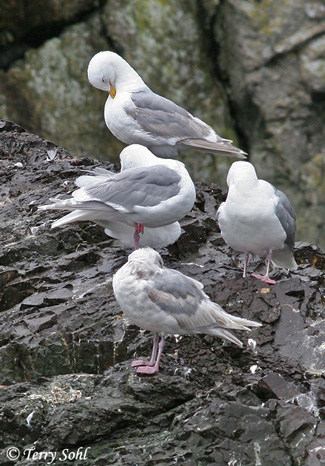
The Glaucous-winged Gull is a large gull normally found along the Pacific coast, breeding from the Washington coast northward through the southern and western coasts of Alaska, and found along the entire North American coastline in winter and migration. The species is only rarely found inland, and was unknown in South Dakota until an individual was spotted along the Missouri River in the winter of 2008-2009. Sightings are rare but there have been multiple other sightings since then.
Habitat
The Glaucous-winged Gull inhabits coastal marine environments, including rocky shorelines, sandy beaches, bays, estuaries, harbors, mudflats, and offshore islands. It breeds primarily on coastal cliffs, islands, and headlands, often near productive marine waters. Outside the breeding season, it is commonly found around ports, fishing docks, landfills, and other coastal areas where food is abundant.
Diet
Omnivorous, feeding on a wide variety of food items including fish, crustaceans, squid, sea urchins, eggs, small birds and mammals, and occasionally plant material. Will also sometimes scavenge for trash and garbage and dumps and other sites.
Behavior
The Glaucous-winged Gull is an adaptable and opportunistic bird that forages along shorelines, over open water, and around human settlements. It feeds by scavenging, stealing food from other birds, and capturing fish and marine invertebrates, often gathering in large flocks where food is plentiful. During the breeding season, it becomes highly territorial and aggressively defends its nest and young from intruders.
Nesting
Non-breeder in South Dakota. In range, the Glaucous-winged Gull nests in loose colonies on coastal islands, cliffs, rocky shorelines, beaches, and occasionally on rooftops. The nest is a shallow scrape or mound constructed from grasses, seaweed, mosses, and other available vegetation. The female typically lays 2–3 olive or brownish, dark-spotted eggs, and both parents share incubation and care of the chicks.
Song
The Glaucous-winged Gull gives a variety of loud, harsh calls, including deep, laughing keow notes and repeated yelps used in territorial defense and social interactions. Like many large gulls, it performs a characteristic long call with the head thrown back during courtship and territorial displays. Chicks and adults also produce a range of softer contact calls and alarm notes within breeding colonies.
Migration
Breeds along coastlines throughout most of Alaska except the northern shores, as well as the western Canada coastline and southward to Washington state. Winters in much of the same area, but also extends southward along the entire coastline of North America.
Interactive eBird map
Click here to access an interactive eBird map of Glaucous-winged Gull sightings
Similar Species
Similar to other large gulls, including Herring , Glaucous , and Thayer's gulls. Click here for a page on tips for differentiating between these and other gulls.
Conservation Status
The Glaucous-winged Gull is classified as Least Concern by the International Union for Conservation of Nature because of its broad distribution along the Pacific coast of North America and its relatively large population. Although some local populations face pressures from pollution, fisheries interactions, and changes in marine ecosystems, the species remains widespread and is not currently considered globally threatened.
Further Information
- eBird - Glaucous-winged Gull
- Audubon Field Guide - Glaucous-winged Gull
- Cornell Lab of Ornithology - All About Birds: Glaucous-winged Gull
Photo Information
June 24th, 2007 - Off the coast of Seward, Alaska -- Terry Sohl
