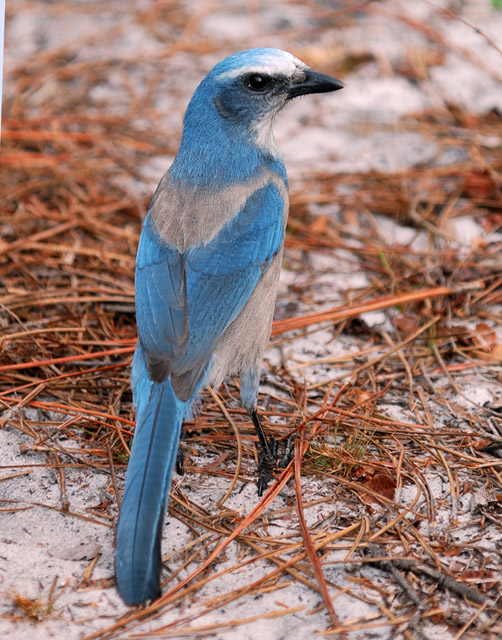
ID Keys: Blue wings and tail, blue head with white on forehead and
throat, gray on back, grayish underparts
The
Florida Scrub-Jay is aptly named, found nowhere else in the world other than
the state of Florida, and found in areas with short, scrubby oak trees. They
were once considered as part of one scrub-jay species, along with the
Western Scrub-Jay and
Island
Scrub-Jay of the western United States. Florida Scrub-Jays are
considered a "threatened" species in the United States. Their
preferred habitat is only found in scattered locations, and heavy
development of central and coastal Florida has resulted a significant loss
of habitat. Their preferred scrubby oak woodlands are also naturally
maintained by fire, but with heavy urban development in Florida, fire
suppression has altered the natural ecosystems, including the habitats that
Florida Scrub-Jays depend upon. In addition to habitat loss,
fragmentation of remaining habitat is an issue. Most Florida
Scrub-Jays are very sedentary, rarely leaving the general location where
they breed, and as habitat fragmentation continues to occur, remaining
populations become increasingly isolated from each other. Florida
Scrub-Jay populations have declined by over 90% over the last century.
Habitat
The Florida Scrub-Jay is found almost exclusively in Florida's scrub habitats, including oak scrub, scrubby flatwoods, and sandy pine-oak ecosystems. It requires open areas with scattered shrubs and small trees, maintained by periodic fire to prevent the habitat from becoming too dense. Because of its specialized habitat needs, the species is largely restricted to isolated patches of suitable scrub vegetation throughout Florida.
Diet
Omnivorous, but feeds heavily on insects, spiders, and other invertebrates during most months. They will also feed on fruits, berries, and seeds, and often depend heavily on acorns during the winter months, when other food items are not as available.
Behavior
Uses a variety of foraging techniques, depending upon food item and location. They will often stash large numbers of acorns in sandy soil areas for later use.
Nesting
Florida Scrub-Jays have a cooperative nesting behavior, where one adult breeding pair is assisted by multiple "helper" birds, with the helpers often previous offspring of the nesting pair. Nesting usually occurs in small scrub oak trees, between 3 and 10 feet from the ground. The female lays 3 or 4 eggs. The young leave the nest after 15 to 20 days, but typically remain close to the parents for many weeks after fledging.
Song
The Florida Scrub-Jay is a vocal species that uses a variety of harsh calls, scolds, whistles, and chatter to communicate with family members and defend territories. One of its most common sounds is a sharp, raspy zreep or scolding call given when predators or intruders are nearby. Family groups maintain contact through a range of quieter calls while foraging and moving through scrub habitat.
Migration
The Florida Scrub-Jay is a nonmigratory species that remains in the same general area throughout the year. Individuals typically spend their entire lives within or near their family territory, and young birds often stay with their parents for several years as helpers before establishing territories of their own. Because it does not migrate, the species is highly dependent on the availability and quality of local scrub habitat.
In range, not likely to be confused with other species. They are similar in appearance to the Western Scrub-Jay and the Island Scrub-Jay , two species with ranges far from Florida.
Conservation Status
The Florida Scrub-Jay is classified as Vulnerable by the International Union for Conservation of Nature and is listed as Threatened under the U.S. Endangered Species Act. Its population has declined because of habitat loss, fragmentation, urban development, and the suppression of natural fires that maintain Florida's scrub ecosystems. As the only bird species found exclusively in Florida, it is highly dependent on ongoing habitat management and conservation efforts.
Photo Information
Photo taken by VTHokiEE06 - November 20th, 2009 - Cruickshank Sanctuary, Brevard County, Florida - Photo licensed under Creative Commons Attribution NonCommercial NoDerivs 2.0 Generic License.