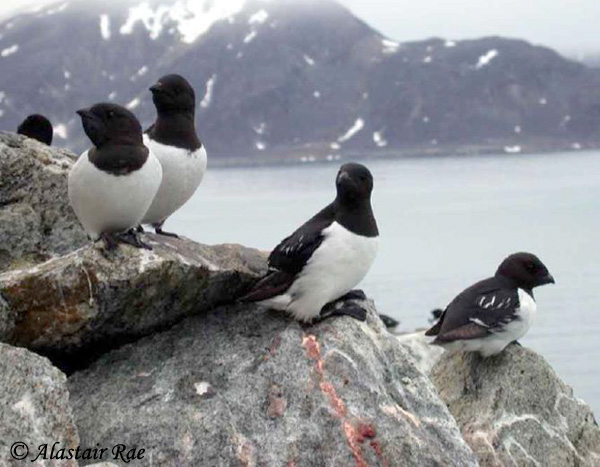
ID Keys: Small size, black upperparts, head, and neck with white
belly and undertail, tiny stubby bill
The
Dovekie is a tiny member of the Auk family, standing only 8 inches tall but
wearing the same basic black-and-white plumage pattern of some of the larger
Auk species. They are sometimes called "Little Auks". Despite
their small size, they nest furthern north than any of the Auk species, with
huge numbers nesting in traditional nesting sites like those in northwestern
Greenland. Small colonies can be found in a very few spots off the
coast of western Alaska and northeastern Canada. Even during the
winter months, most Dovekie stay in the far north, where they can often be
found around the edge of the pack ice. Small numbers can occasionally
be found southward along the Atlantic Coast in winter, and more rarely,
storm events may blow small numbers inland.
Habitat
The Dovekie inhabits cold Arctic and subarctic marine environments of the North Atlantic Ocean. It breeds in enormous colonies on rocky cliffs, talus slopes, and boulder fields in places such as Greenland, Iceland, and the high Arctic islands of the North Atlantic. Outside the breeding season, Dovekies remain at sea, occupying cold offshore waters, pack ice edges, and productive marine areas where plankton is abundant.
Diet
The Dovekie feeds primarily on tiny zooplankton, especially copepods and other small crustaceans. It captures prey by diving underwater and swimming with its wings through cold Arctic and North Atlantic waters. Small marine invertebrates make up the vast majority of its diet, although it may occasionally consume other planktonic organisms.
Behavior
The Dovekie is a highly social seabird that nests in enormous colonies, sometimes containing hundreds of thousands of birds. It is an agile diver, using its wings to propel itself underwater while feeding on zooplankton in cold Arctic seas. At breeding colonies, Dovekies are constantly active, commuting between feeding areas and nesting sites while producing a continuous chorus of calls. Outside the breeding season, they spend virtually their entire lives at sea, often gathering in large flocks over productive marine waters.
Nesting
The nest of a Doviekie is a simple layer of pebbles lined with lichens, placed in a crack or crevice on a cliff face or on a rocky slope. The female lays a single egg, and both parents take turns incubating it. Upon hatching, both parents help to feed the youngster.
Song
The Dovekie is highly vocal at breeding colonies, where it produces a variety of rapid chattering, trilling, buzzing, and squeaky calls. The overall sound of a large colony is often described as a continuous chorus of high-pitched twittering and conversational chatter. Away from breeding sites, birds are generally silent.
Migration
Breeds in very far north Arctic locations, with northwestern Greenland having the biggest nesting populations in the Western Hemisphere. Large numbers remain in the far north as long as open water is available. Small numbers may stray as far south as New England (and rarely further) in the winter.
If seen well, unlikely to be confused with another species within its range, due to its small size and unique features compared to other auk species.
Conservation Status
The Dovekie is generally considered a species of low conservation concern because of its very large global population and extensive Arctic breeding range. However, it is considered vulnerable to climate change because its survival depends heavily on cold Arctic waters that support the copepods and other zooplankton forming the bulk of its diet. Changes in sea ice, ocean temperatures, and marine food webs could affect populations in parts of its range. Overall, the species remains abundant, but long-term monitoring is important as Arctic ecosystems continue to change. The IUCN currently lists the Dovekie as a species of "Least Concern".
Photo Information
Photo taken by Alastair Rae - July 14th, 2004 - Svalbard - Licensed under Creative Commons Attribution-ShareAlike 2.0 Generic License.