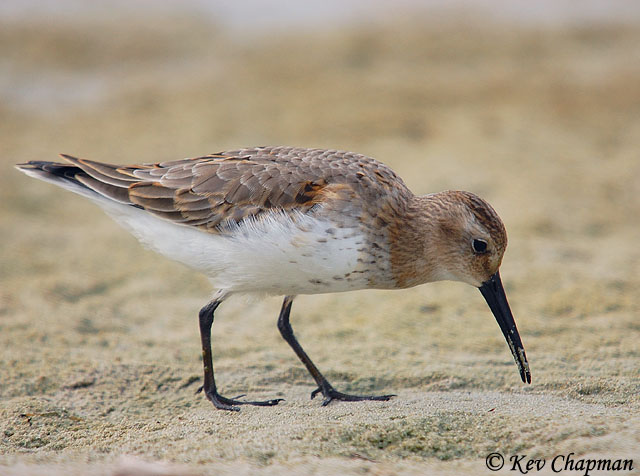
The Curlew Sandpiper is primarily a bird of the Old World, breeding in Siberia, and wintering in southeast Asia or Australia. In North America, they are mostly rare visitors, with individual birds sighted in many locations across the continent, both along the coast, and in the interior of the continent. They have nested occasionally in Alaska, but not consistently, and only in very small numbers.
Habitat
The Curlew Sandpiper breeds on Arctic tundra in northern Siberia, where it nests in wet sedge meadows, marshy tundra, and areas near ponds and shallow wetlands. During migration and winter, it occupies a wide variety of coastal and inland wetlands, including tidal mudflats, estuaries, lagoons, salt marshes, salt ponds, flooded fields, sewage ponds, and shallow freshwater wetlands. The species is strongly associated with mudflats and other soft-bottomed habitats where it can probe for invertebrate prey.
Diet
The Curlew Sandpiper feeds primarily on aquatic invertebrates, including insects and their larvae, small crustaceans, worms, mollusks, and other tiny organisms found in mud and shallow water. It forages by probing rapidly with its slightly downcurved bill in mudflats, marshes, and shallow wetlands. During the breeding season, insects become especially important, while migrating and wintering birds often consume large numbers of crustaceans and other aquatic prey.
Behavior
Forages by walking in shallow water, using its bill to probe in the bottom mud. They will also pick items directly off the water's surface or the ground with their bill.
Nesting
The nest of a Curlew Sandpiper is a shallow depression on the ground, lined with mosses, lichens, and leaves. The female usually lays 4 eggs, and she alone incubates them. When the eggs hatch, the young quickly leave the nest and feed themselves. The female will stay with them and protect them until they fledge.
Song
The Curlew Sandpiper gives a variety of high-pitched whistles and trills. In flight, it often utters a sharp, rolling churrup call that is higher and more musical than the calls of many similar sandpipers. On the breeding grounds, males produce a more elaborate series of trills and bubbling notes during display flights and territorial interactions.
Migration
The Curlew Sandpiper is a remarkable long-distance migrant that breeds on the Arctic tundra of northern Siberia. After breeding, it migrates south along major Eurasian and African flyways to winter in Africa, southern Asia, Australia, and New Zealand. During migration, vast numbers stop at coastal mudflats, estuaries, and inland wetlands to refuel. In North America, the species is a rare but regular vagrant, with occasional records from both coasts and the interior, including scattered observations in the Great Plains.
Similar Species
Dunlin : The Curlew Sandpiper has longer legs, a longer and more distinctly downcurved bill, and a more elegant appearance than a Dunlin. In breeding plumage, Curlew Sandpipers show rich rusty-red underparts extending across most of the breast and belly, while Dunlins have a prominent black belly patch.
Red Knot : Red Knots have a shorter, straight bill and a stockier, more compact body shape than Curlew Sandpipers. In breeding plumage, Red Knots show a smooth brick-red face and underparts, whereas Curlew Sandpipers have a longer bill, whiter undertail area, and a more elongated profile.
Conservation Status
The Curlew Sandpiper has experienced significant population declines and is considered a species of conservation concern in many parts of its range. Major threats include the loss and degradation of coastal wetlands, tidal mudflats, and other critical stopover habitats used during migration, particularly along major migratory flyways. Climate change, habitat alteration on Arctic breeding grounds, and disturbance at key staging areas may also affect populations. Although still widespread across Eurasia, Africa, Asia, and Australasia, continued conservation of migratory wetlands is considered essential for the species' long-term future. The IUCN lists the Curlew Sandpiper as a species that is "vulnerable" .
Photo Information
Photo taken by Kev Chapman - Photo licensed under Creative Commons Attribution 2.0 Generic License.
Interactive eBird Map
Click to access the interactive eBird species sightings page for Curlew Sandpiper
