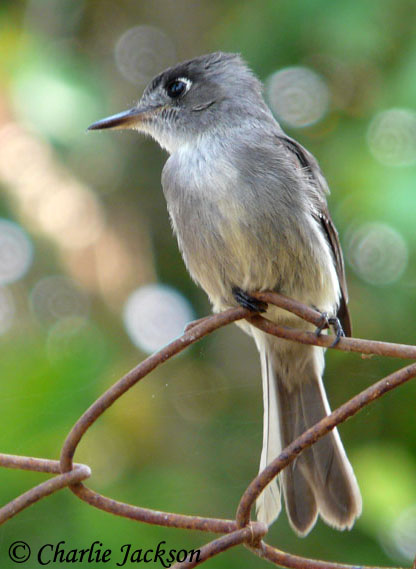
The Cuban Pewee is normally found in Cuba and islands in the western Caribbean. They are but a rare vagrant to the United States, having first been identified in the United States in 1995. They are very similar in size, structure, and plumage to the Eastern Wood-Pewee, a quite common species in the Eastern United States, and the two species share the same general habitat preferences. Due to the similarity to the Eastern Wood-Pewee, it is possible the species is a more frequent visitor to the United States, but simply isn't identified very often. Due to the main feature that differentiates it from other Pewee species, it is sometimes referred to as the "Crescent-eyed Pewee". Formerly, the Cuban Pewee, the Jamaican Pewee, and the Hispaniolan Pewee were all considered one species, the Greater Antillean Pewee.
Habitat
The Cuban Pewee inhabits woodlands, forest edges, pine forests, dry forests, gardens, parks, plantations, and other lightly wooded habitats throughout Cuba and nearby islands. It favors areas with scattered trees and open spaces that provide suitable perches for catching flying insects. The species is commonly found from lowlands to foothill elevations and adapts well to both natural and human-modified landscapes.
Diet
The Cuban Pewee feeds primarily on flying insects, including flies, mosquitoes, beetles, moths, ants, and other small aerial invertebrates. Like other pewees, it typically hunts from an exposed perch, making short flights to capture prey in midair before returning to the same perch. Small fruits may occasionally be eaten, but insects make up the vast majority of its diet.
Behavior
The Cuban Pewee is a typical sit-and-wait flycatcher, spending long periods perched quietly on exposed branches while watching for insects. When prey is spotted, it makes a short aerial sally to capture the insect and then usually returns to the same perch. It is often encountered singly or in pairs and can be surprisingly conspicuous because of its habit of perching in the open while repeatedly giving its characteristic whistle. During the breeding season, males defend territories through singing and display flights.
Nesting
The nest of a Cuban Pewee is a small cup built of grasses, rootlets, lichens, moss, animal hair, or other fine materials. The female usually lays between 2 and 4 eggs, and the female alone incubates the eggs. Once the eggs hatch, both parents help to feed and raise the young. The young fledge after about 16 days.
Song
The Cuban Pewee gives a clear, plaintive, whistled song usually described as pee-wee repeated at regular intervals from exposed perches. This simple, mournful whistle is one of the most familiar bird sounds in many wooded areas of Cuba. Calls also include soft chips, short whistles, and quiet contact notes used between mates and neighboring birds.
Migration
Considered a permanent resident throughout its normal range in the western Caribbean.
Similar Species
Very similar in overall appearance to the Eastern Wood-Pewee , a common species in the eastern United States. The white crescent behind the eye is the easiest way to differentiate the Cuban Pewee from the Eastern Wood-Pewee.
Conservation Status
The Cuban Pewee is generally considered a species of low conservation concern. It remains widespread and fairly common throughout much of Cuba and occurs in a variety of habitats, including forests, woodland edges, parks, gardens, and other human-modified landscapes. Although local habitat loss can affect some populations, the species is currently regarded as stable and is not considered globally threatened. The IUCN lists the Cuban Pewee as a species of "Least Concern".
Photo Information
Photo taken by Charlie Jackson - March 30th, 2011 - Zapata, Cuba - Photo licensed under Creative Commons Attribution 2.0 Generic License.
Interactive eBird Map
Click to access the interactive eBird species sightings page for Cuban Pewee
