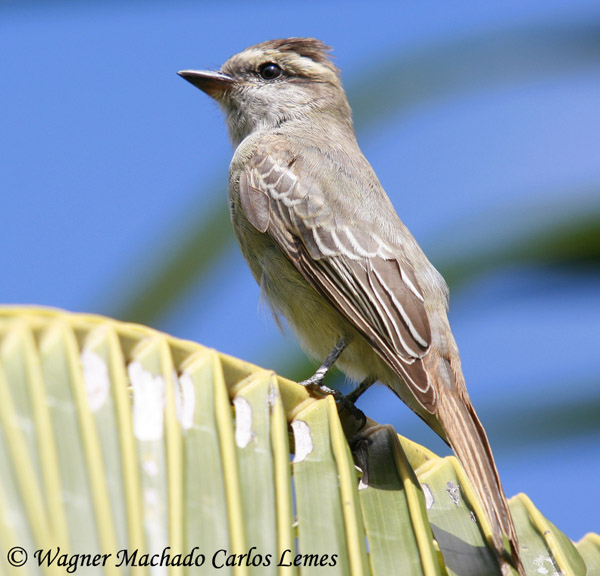
The Crowned Slaty Flycatcher is a small flycatcher species normally found in South America. They are migratory and a handful of cases have occurred where birds have appeared far out of normal range. In the North American ABA area, they are known from a single sighting, when a bird was found in southern Louisiana in 2008. Paul Conover and Buford Myers found the bird, knew it was a one-of-a-kind specimen, and, sadly, decided to "collect" the bird, supposedly for "study". The bird is now on display at the Louisiana State Museum of Natural Science. The killing of the only bird of its kind to ever find its way to North America raised considerable ire among the birding and conservation community. The two men who saw it never provided any opportunity for any one else to enjoy the bird's presence, and given that it is a common species in South America and much is known about it, "collecting" it for study is, at best, QUESTIONABLE!!! (Pardon the editorial, but this case really irritates me).
Habitat
The Crowned Slaty Flycatcher inhabits open woodlands, forest edges, gallery forests, savannas, scrubby habitats, agricultural areas, and scattered trees in open country. It is most often found in semi-open landscapes where it can use exposed perches to watch for flying insects. Across much of South America, the species favors woodland borders, riparian corridors, and lightly wooded habitats rather than dense forest interiors.
Diet
The Crowned Slaty Flycatcher feeds primarily on insects captured in flight. Its diet includes flies, beetles, wasps, bees, ants, grasshoppers, and other flying insects, which it catches by making short aerial sallies from exposed perches. It may also occasionally consume small fruits and berries, especially outside the breeding season.
Behavior
The Crowned Slaty Flycatcher typically hunts from exposed perches in trees, shrubs, fence lines, and woodland edges, watching for insects before making quick flights to capture them. It is often conspicuous and active, frequently returning to the same perch after a foraging flight. During the breeding season, males defend territories and may raise a concealed orange-yellow crown patch during displays or aggressive encounters. The species is usually seen singly or in pairs, although it may join mixed-species flocks during migration or on the wintering grounds.
Song
The Crowned Slaty Flycatcher gives a variety of sharp, ringing whistles, squeaky notes, and chattering calls. Its song often consists of clear, repeated phrases and whistled notes delivered from exposed perches, while calls include sharp chips and scolding sounds used during territorial interactions and communication between mates.
Migration
Breeds in Paraguay, Uruguay, Argentina, Brazil, and Bolivia. Some may be permanent residents in central South America, but most are migratory, moving northward after the breeding season to as far north as Ecuador, Columbia, and Venezuela.
Similar Species
The Crowned Slaty Flycatcher is a close relative of the Variegated Flycatcher , another species found in South America that has been occasionally found as a vagrant in North America.
Conservation Status
Overall populations are considered stable, they are found over a wide geographic area, and they are common in parts of their range. The IUCN lists the Crowned Slaty Flycatcher as a species of "Least Concern".
Photo Information
Photo taken by Wagner Machado Carlos Lames - December 24th, 2008 - Goiania, Golas, Brazil - Photo licensed under Creative Commons Attribution 2.0 Generic License.
Interactive eBird Map
Click to access the interactive eBird species sightings page for Crowned Slaty Flycatcher
