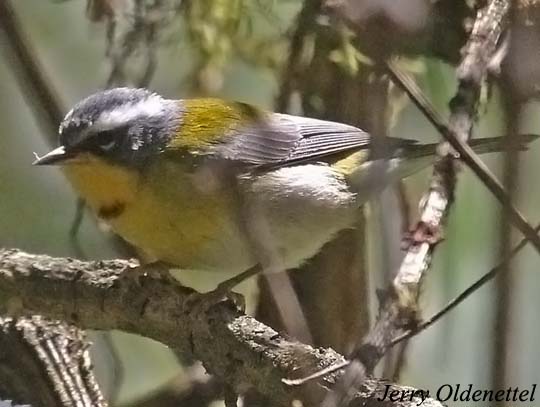
The Crescent-chested Warbler is found in parts of Mexico and Central America, but was unknown in the United States until 1983, when a bird was confirmed at Fort Huachuca in southern Arizona. Another was found in southern Arizona the next year, and sporadic reports have occasionally occurred since then. A handful of records have now also been recorded near the Rio Grande in Texas.
Habitat
The Crescent-chested Warbler inhabits montane pine, pine-oak, and cloud forests of Mexico and northern Central America. It is most often found in cool, humid mountain woodlands with a well-developed understory, where it forages among shrubs, small trees, and lower forest vegetation. The species is typically associated with middle and high elevations and is often seen moving through forest edges, clearings, and mixed-species feeding flocks.
Diet
The Crescent-chested Warbler feeds primarily on insects and other small arthropods. Its diet includes caterpillars, beetles, flies, spiders, and various insect larvae that it gleans from leaves, twigs, and branches while actively foraging through the understory and lower levels of montane forests.
Behavior
Despite nests being located on or near the ground, foraging is typically done by moving through the forest canopy, gleaning insects from foliage and branches. They sometimes hang upside down while foraging, similar to the manner of a chickadee.
Nesting
The nest is a cup built either very low in vegetation or on the ground, usually placed on a steep slope. The female lays between 2 and 4 eggs and she alone incubates them. Both parents help to feed the young once they hatch.
Song
The Crescent-chested Warbler gives a bright, musical song composed of clear whistles and trilled phrases, often delivered from the midstory or canopy of montane forests. Calls include sharp chips and thin contact notes used while foraging and moving through mixed-species flocks.
Migration
The Crescent-chested Warbler is generally considered nonmigratory. It occurs year-round in the montane forests of Mexico and northern Central America, where most populations remain within their breeding areas throughout the year. Some individuals may make short elevational or local seasonal movements in response to weather, food availability, or breeding conditions, but the species does not undertake long-distance migrations.
Similar Species
Northern Parula : The Crescent-chested Warbler has a bold white eyebrow, a distinctive yellow crescent across the upper chest, and lacks the Northern Parula's contrasting blue-gray upperparts. Northern Parulas show a broken white eye arc rather than a strong eyebrow and typically have a more colorful blue-gray-and-yellow appearance.
Tropical Parula : Tropical Parulas are smaller, more compact, and show blue-gray upperparts with a yellow throat and chest, often accompanied by a chestnut breast band in adults. Crescent-chested Warblers lack the blue-gray coloration and are distinguished by their prominent white eyebrow and characteristic yellow crescent-shaped chest marking.
Conservation Status
The Crescent-chested Warbler is generally considered a species of low conservation concern. It remains fairly common across much of its range in the montane forests of Mexico and northern Central America, where it occupies pine-oak woodlands, cloud forests, and other mountain habitats. Although local populations can be affected by deforestation, logging, and habitat fragmentation, the species maintains a relatively broad range and is not currently considered globally threatened. The IUCN lists the Crescent-chested Warbler as a species of "Least Concern" .
Photo Information
Photo by Jerry Oldenettel - Photo licensed under Creative Commons Attribution NonCommercial ShareAlike 2.0 Generic License
Interactive eBird Map
Click to access the interactive eBird species sightings page for Crescent-chested Warbler
