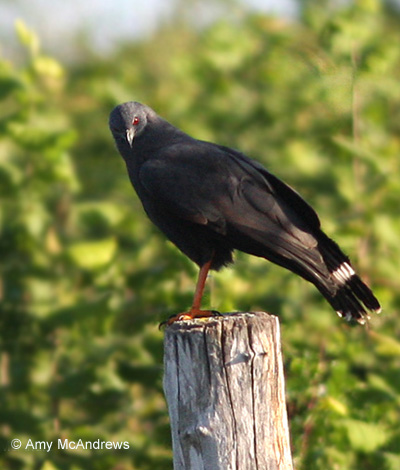
The Crane Hawk is a slim, unusual hawk of the American tropics. They are normally found in Central America and much of South America, as well as part of Mexico. They were unknown in the United States until 1988, when a single Crane Hawk spent the winter in south Texas. Crane Hawks have an unusual structure with very long legs and relatively small feet. While Crane Hawks will hunt by flying and spotting prey, much of their hunting is done by climbing through the forest canopy, reaching into tree cavities or other nooks and crannies with their long legs, and plucking prey from hiding spots that other raptors simply often can't reach.
Habitat
The Crane Hawk inhabits tropical and subtropical forests, forest edges, gallery forests, wooded wetlands, mangroves, palm groves, savannas with scattered trees, and riparian woodlands. It is especially associated with areas containing dense vegetation and mature trees where it can search for prey in cavities, bromeliads, vine tangles, and other concealed locations. In the United States, it occurs only rarely in southern Texas, while most of its range extends through Mexico, Central America, and much of South America.
Diet
Feeds on a variety of small animals, including frogs, small lizards and snakes, bats, birds and young fledglings, large insects, and small rodents.
Behavior
The Crane Hawk is a highly specialized predator known for its unusually long legs and remarkable flexibility. It often climbs through trees and reaches deep into cavities, bromeliads, palm crowns, and dense vegetation to extract prey such as lizards, snakes, nestling birds, large insects, bats, and small mammals. Unlike many hawks that hunt primarily in open flight, Crane Hawks frequently move deliberately through the forest canopy, using their long legs almost like tools to probe inaccessible spaces. They are usually encountered singly or in pairs and often hunt along forest edges and riparian corridors.
Nesting
The Crane Hawk builds a stick nest high in a tree, often within the canopy of a forest, wooded wetland, riparian corridor, or palm grove. The nest is typically lined with green leaves and placed where it is concealed by surrounding foliage. Clutches usually contain 1–2 eggs, and both adults participate in caring for the young, although the female performs most of the incubation.
Migration
The Crane Hawk is largely nonmigratory throughout most of its range from Mexico through Central America and much of South America. Most populations remain year-round within suitable forest and woodland habitats, making only local movements in response to food availability, seasonal flooding, or changing environmental conditions. The species is generally considered a resident raptor rather than a long-distance migrant.
Similar Species
Somewhat similar to Northern Harrier in overall structure, but distinctive if seen well.
Conservation Status
Crane Hawk populations appear to be slowly declining, likely due to habitat loss. However, the species has a very wide range in the American tropics, and there are currently no perceived major threats to Crane Hawk populations. The IUCN cites the Craen Hawk as a species of "Least Concern".
Photo Information
Photo by Amy McAndrews - December, 2009 - Yucatan, Mexico - Photo licensed under Creative Commons Attribution Non-Commercial No Derivs 2.0 Generic License
Interactive eBird Map
Click to access the interactive eBird species sightings page for Crane Hawk
