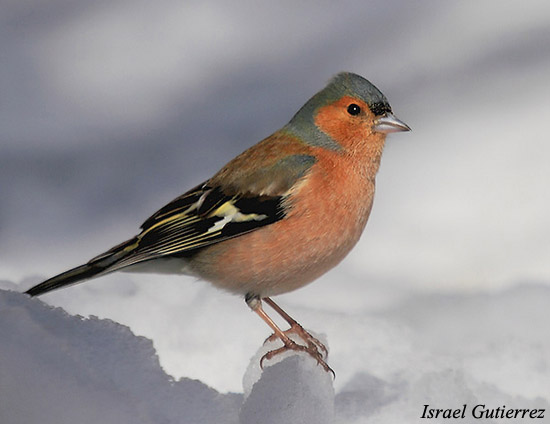
The Common Chaffinch is a bird of the Old World, with a range that covers most of Europe, northwest Africa, and northwestern parts of Asia. A popular bird in Great Britain, they were also introduced in a number of former British colonies. Populations persist in New Zealand where they are one of the most numerous songbirds, while small populations persist in South Africa. In the Western Hemisphere, they are rare vagrants, with most birds found near the Atlantic coastline of eastern Canada and the northeastern United States.
Habitat
The Common Chaffinch inhabits a wide variety of wooded and semi-open habitats, including deciduous forests, mixed woodlands, forest edges, parks, gardens, orchards, hedgerows, farmland with scattered trees, and suburban areas. It is one of the most widespread and familiar songbirds across Europe, parts of western Asia, and northwestern Africa, thriving wherever trees and shrubs provide nesting sites and cover.
Diet
The Common Chaffinch feeds on a variety of seeds, grains, buds, berries, and other plant material. During the breeding season it also consumes large numbers of insects and spiders, including caterpillars, beetles, flies, and other small invertebrates, which are especially important for feeding nestlings.
Behavior
The Common Chaffinch spends much of its time foraging on the ground beneath trees and shrubs, searching for seeds, insects, and other food items. It is often seen singly, in pairs, or in flocks, especially outside the breeding season when it may join mixed groups of finches and other small songbirds. Males are strongly territorial during the breeding season and frequently sing from exposed perches to defend their territories and attract mates. The species adapts well to human-altered landscapes and is a familiar bird in parks, gardens, and agricultural areas throughout much of its range.
Nesting
The nest is a small cup built in the fork of a tree by the female. Clutch size is typically 3 to 5 eggs. Incubation and time to fledge are both about 2 weeks. Both the male and female take care of the young after hatching.
Song
The Common Chaffinch has a cheerful, musical song often described as a rapid series of notes that accelerates and ends with a distinctive flourish or flourish-like trill. Across much of Europe, it is one of the most familiar bird songs of woodlands and gardens. Calls include a sharp fink note—one source of the bird's English name—as well as a variety of softer contact calls used between flock members and mates.
Migration
Considered a permanent resident in warmer parts of its normal Eurasian range, but populations that breed in colder climates are migratory. In many colder areas, the females alone migrate to warmer climates for the winter, while males stay behind for the winter.
Feeders
Common Chaffinch are common at feeders in their normal range, attending for most commonly offered seeds.
Similar Species
Unique and easily identified compared to native North American birds. May possibly be confused with Brambling , another visitor from the Old World. The Common Chaffinch is generally grayer and pinker below, with males showing a blue-gray crown and pink breast. Brambling has a bright orange breast, orange shoulders, and a conspicuous white rump that is often visible in flight. In winter, Bramblings also show more white on the upperparts and a stronger black-and-orange contrast than Common Chaffinches.
Conservation Status
The Common Chaffinch is considered a species of low conservation concern and remains one of the most abundant and widespread songbirds in Europe. Its large population, broad geographic range, and ability to thrive in forests, farmland, parks, gardens, and suburban habitats have helped keep populations generally stable. Although local declines may occur because of habitat changes, disease outbreaks, or agricultural intensification, the species remains secure overall. The IUCN considers the Common Chaffinch to be a species of "least concern".
Photo Information
Photo taken by I srael Gutierrez - March 7th, 2011 - Onis, Asturias, Spain - Photo licensed under Creative Commons Attribution-NonCommercial-ShareAlike 2.0 Generic License
Interactive eBird Map
Click to access the interactive eBird species sightings page for Common Chaffinch
