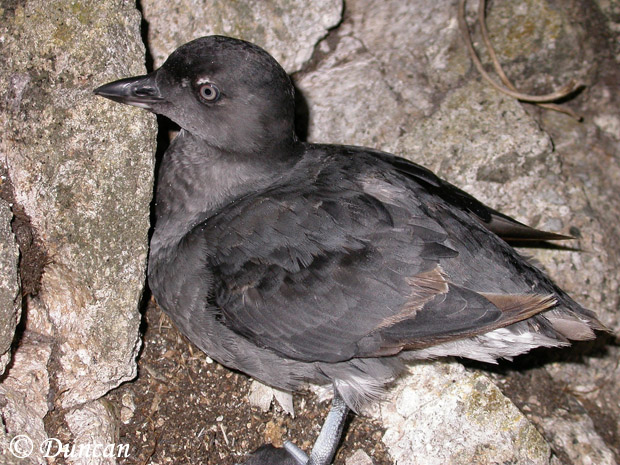
The Cassin's Auklet is a widespread auk species that's found on the Pacific coast from Alaska to Mexico. Both their range and total population are greater than other auk species found in the Pacific. They rely less on specialized island habitats than other auk species (for example, the need for rocky offshore islands for many auk species in the Pacific), and will nest near many different island habitats, as long as nesting burrows can be built, and predators aren't prevalent. Overall, their distinguishing characteristic compared to other Auklet species is the lack of distinct plumage marks, as they are decidedly plainer than other Auklet species in their range.
Habitat
Nests on islands free of terrestrial predators, with a habitat preference much less selective than many other auklet species. Outside of the breeding season, they are often found near their breeding colonies, but they can also be found far out to sea.
Diet
The Cassin's Auklet feeds primarily on zooplankton, especially krill, copepods, and other small crustaceans captured while diving underwater. It also consumes small fish, squid, and marine larvae when available, using its wings to propel itself through the water in pursuit of prey.
Behavior
The Cassin's Auklet spends most of its life at sea, foraging by diving underwater for krill and other planktonic prey. It is primarily active around breeding colonies at night, a behavior that helps reduce predation on adults, eggs, and chicks. During the breeding season, adults commute between offshore feeding areas and island nesting colonies, often returning under cover of darkness to burrows where they raise a single chick.
Nesting
Nesting occurs in a burrow dug in the ground, with both the male and female helping to excavate then nesting cavity. No nesting material is used in the burrow; the female lays a single egg on the burrow floor. Both parents help to incubate the egg, and both parents help raise the young after it hatches.
Song
The Cassin's Auklet is usually silent at sea but becomes surprisingly vocal at breeding colonies. Its calls are often described as eerie, wheezing, groaning, or donkey-like cries, along with raspy chatter and moaning notes given from burrows and colony areas at night.
Migration
The Cassin's Auklet breeds on islands along the Pacific Coast from the Aleutian Islands south to Baja California. Unlike many seabirds, it is not a strong long-distance migrant; most birds remain in the northeastern Pacific year-round, shifting seasonally to areas with abundant plankton and favorable ocean conditions. After breeding, individuals disperse widely offshore and may occur far from land, especially during winter.
Similar Species
Generally plainer than other Auklet species, with a thicker bill and body shape than Murrelet species. If seen well in range, it's unlikely to be confused with another species.
Conservation Status
The Cassin's Auklet is generally considered a species of moderate conservation concern overall, but some populations have experienced significant declines. Major threats include climate-driven changes in ocean productivity, marine heat waves, oil spills, entanglement in fishing gear, and introduced predators such as rats and cats on nesting islands. Because the species depends heavily on krill and other plankton-rich marine ecosystems, changes in ocean conditions can have substantial effects on breeding success and survival. The IUCN lists the Cassin's Auklet as a species that is "near threatened".
Photo Information
Photo taken by Duncan - August 2003 - Farallon Islands, off the coast of California - Photo licensed under Creative Commons Attribution ShareAlike 2.0 Generic License .
Interactive eBird Map
Click to access the interactive eBird species sightings page for Cassin's Auklet
