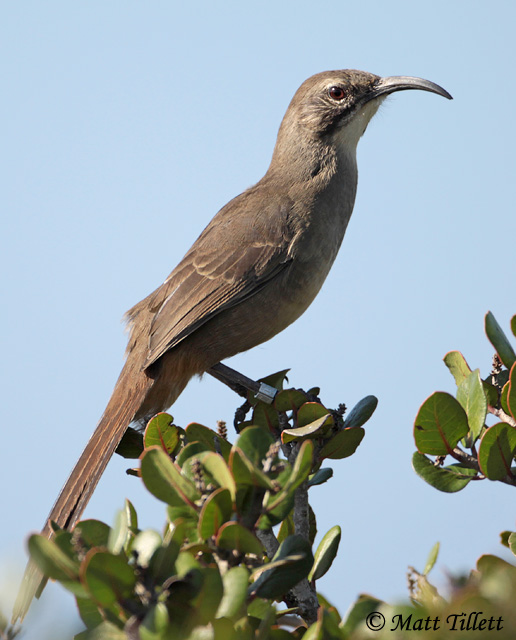
The California Thrasher is common in many parts of their limited range in western and central California, and in Baja California. They are similar in appearance to some of the other western Thrasher species, but the California Thrasher is the only one with a range that includes areas along the coast. Populations have declined in many parts of their range, as conversion of their native habitat to urban uses has resulted in significant habitat loss and fragmentation. However, they are still very common in many parts of their normal range, and populations are not considered seriously threatened or endangered.
Habitat
The California Thrasher inhabits dense chaparral, coastal sage scrub, brushy foothills, oak woodland edges, and thick shrubby canyons of California and northern Baja California. It prefers extensive stands of dense native shrubs where it can forage on the ground and remain concealed within heavy cover.
Diet
The California Thrasher feeds primarily on insects, spiders, beetles, ants, caterpillars, and other invertebrates that it uncovers by probing and scratching through leaf litter with its long curved bill. It also eats berries, fruits, and seeds, particularly during fall and winter when insect prey is less abundant.
Behavior
The California Thrasher is a secretive but active bird that spends much of its time foraging on or near the ground beneath dense shrubs. It uses its long curved bill to probe through leaf litter and loose soil for insects and other prey, often remaining hidden in chaparral cover. Although it can be difficult to see, it frequently sings from exposed shrub tops or small trees during the breeding season and typically remains on territory year-round.
Nesting
The nest is an open cup of sticks and twigs lined with finer vegetative material, placed in a thick shrub, usually relatively close to the ground. The female lays 3 or 4 eggs, and both parents help to incubate them. After the eggs hatch, both parents help feed and tend to the nestlings. The young leave the nest after about 2 weeks. California Thrashers will often raise more than one brood per year.
Song
The California Thrasher is renowned for its rich, melodious song, a long series of clear whistles, warbles, and varied musical phrases that can continue for extended periods. Males often sing from exposed perches atop shrubs or small trees, especially during the breeding season. Calls include sharp chucks, chatters, and scolding notes used for alarm and territorial communication.
Migration
Considered a permanent resident throughout their range, with individual birds rarely moving far from their nesting areas.
Feeders
Will attend feeders for various seeds, fruit, and food scraps.
Similar Species
In range, most likely to be confused with Crissal Thrasher or Le Conte's Thrasher. However, ranges of these species barely overlap, so range alone is typically a good factor for distinguishing the California Thrasher. The California Thrasher is darker and browner overall than both the Crissal Thrasher and LeConte's Thrasher, with a noticeably long, strongly curved bill and a relatively plain face. Crissal Thrashers show rich rusty-chestnut undertail coverts and generally occur in dense desert washes and riparian thickets, while LeConte's Thrashers are much paler sandy-gray birds of open deserts and often appear longer-legged and more lightly colored. California Thrashers are primarily birds of chaparral and coastal scrub, where their dark brown coloration blends well with dense shrub cover. Their rich, musical song is also typically fuller and more varied than the songs of the desert-dwelling Crissal and LeConte's Thrashers.
Conservation Status
The California Thrasher is generally considered a species of low conservation concern and remains fairly common throughout much of its restricted range in California and northern Baja California. However, because it is closely tied to chaparral and coastal sage scrub habitats, local populations can be affected by urban development, habitat fragmentation, and changes in fire frequency. Overall, the species remains stable across most of its range where extensive native shrublands persist. The IUCN lists the California Thrasher as a species of "Least Concern" .
Photo Information
Photo taken by Matt Tillett - October 7th, 2011 near San Diego, California - Photo licensed under Creative Commons Attribution 2.0 Generic License .
Interactive eBird Map
Click to access the eBird species page for California Thrasher
