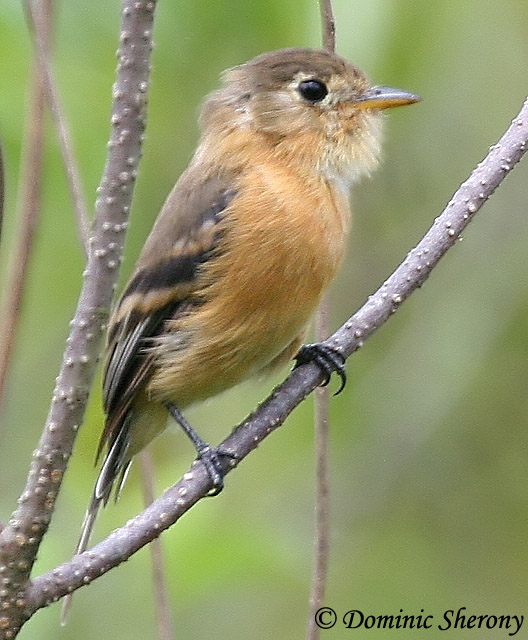
The Buff-breasted Flycatcher is the smallest of the Empidonax flycatchers, and one of the easier ones to identify. Their buffy breast distinguishes them from other Empidonax species, although in some adult birds, the buffy color isn't very apparent in worm plumage of the late summer. The species has started to make a few appearances in southern Texas, in addition to its normal U.S. range in far southern Arizona and New Mexico. The species may have once been more widespread in the open pine forests of the Southwest, before human beings arrived. They prefer pine forests with an open grassy understory, a habitat that is maintained by regular fire. With a human presence, natural fires are suppressed, changing the nature of the understory.
Habitat
Found in open pine woodlands, often in canyons with streams in the U.S. part of their range. Similar habitat is used by the species during the winter and summer months, although they will sometimes utilize lower-elevation habitats in the winter.
Diet
Feeds on insects and spiders.
Behavior
Forages by observing from a perch, and flying out to capture insects in mid-air, or by hovering and gleaning insects from the surface of the foliage or branches. They will also sometimes drop down and grab insects from the ground.
Nesting
The nest of a Buff-breasted Flycatcher is an open cup built of leaves, spider webs, grasses, and roots, with the outside often covered with moss, lichen for bits of bark. The female usually lays 3 or 4 eggs, and she alone incubates them. When the eggs hatch, both parents help to feed the young. The young fledge after about 16 days.
Song
Song of a Buff-breasted Flycatcher consists of two similar musical phrases sung back-to-back... Pi-dew, pi-DEW .
Migration
Many populations are permanent residents. Some short distance movements can occur for the winter, with some populations moving to lower elevations for the winter.
Interactive eBird Map
Click here to access an interactive map of Buff-breasted Flycatcher sightings
Similar Species
In range, most likely to be confused with Dusky Flycatcher or Hammond's Flycatcher . The Buff-breasted Flycatcher is the easiest to identify due to its unique warm, orange-buff underparts, making it much more colorful than its relatives. Between the two look-alikes, the Dusky Flycatcher has a shorter primary projection (shorter wingtips) and a distinct habit of dipping its tail downward, whereas Hammond’s Flycatcher has longer wings, a smaller bill, and typically flicks its wings and tail upward. Geographically, Hammond's prefers dense coniferous forests for breeding, while the Dusky is more common in open mountain chaparral and scrub.
Conservation Status
Populations appear to be decreasing, but they are still found over a relatively wide geographic area and are common in parts of their range. The IUCN lists the Buff-breasted Flycatcher as a species of "Least Concern".
Further Information
- eBird - Buff-breasted Flycatcher
- Audubon Field Guide - Buff-breasted Flycatcher
- Cornell Lab of Ornithology - All About Birds: Buff-breasted Flycatcher
Photo Information
Photo taken by Dominic Sherony - Photo licensed under Creative Commons Attribution ShareAlike 2.0 Generic License .
