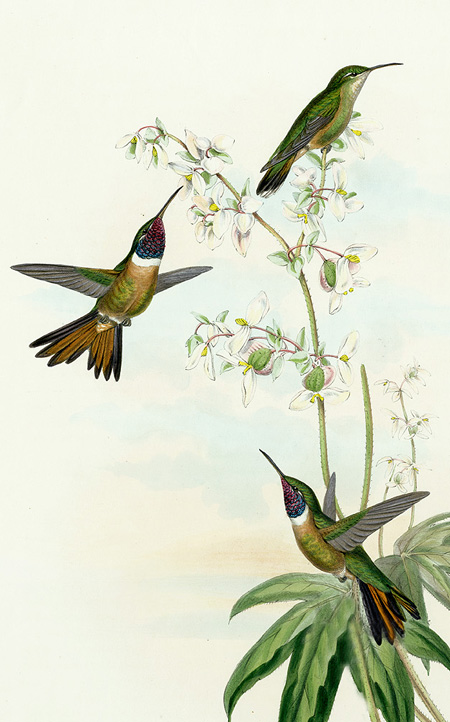
The Bahama Woodstar is, appropriately, the most common hummingbird found on the islands of the Bahamas. They are one of only three endemic birds to the Bahamas. In the U.S., they will sometimes stray to southern Florida, and are most often seen when visiting hummingbird feeders. A unique sub-species with purple feathers on the forehead is found on the island of Inagua, but the subspecies typically doesn't range to the U.S. Bahama Woodstars will breed at any season in their native range, with indications that nesting most often occurs after periods of heavy rain, which results in a flush of flowering plants. However, early- to mid-spring is the most common time for nesting.
Habitat
Will use a variety of semi-open and brushy habitats, including forest edges and brushy undergrowth, areas of low-growing, scrubby vegetation, and suburban gardens.
Diet
Typical diet of Hummingbirds, feeding heavily on nectar. Insects can comprise a large portion of the diet.
Behavior
Aggressive, will fiercely defend prime feeding territory from other hummingbirds and other birds as well. However, they typically show very little fear of human beings, often allowing a very close approach as they perch.
Nesting
Nests are small cups made of downy plant fibers, bits of bark, and spider webs, and will expand as the young grow. Two eggs are typically laid. Nest sites are typically in vegetation from 2 to 12 feet above the ground. Females alone incubate and raise the young.
Interactive eBird Map
Click to access an interactive eBird map of Bahama Woodstar sightings
Song
Song of the Bahama Woodstar is a series of tic notes...tic..tic-tic...tic...tic...tic-tic.
Migration
Most birds are non-migratory. Strays found in southern Florida have appeared at nearly any time of the year.
Feeders
Will attend hummingbird feeders
Similar Species
Berylline Hummingbird
Status
Still common and widespread throughout their normal range in the Bahamas. There are some indications that the species is a more common visitor than once thought in South Florida .
Further Information
Photo Information
Hand-colored lithograph plate of Bahama Woodstar by John Gould, 1861. Gould produced 418 individual hand-colored plates for his monograph on hummingbirds, published in 1861.
Additional Photos
Additional Photos Coming Soon!!
