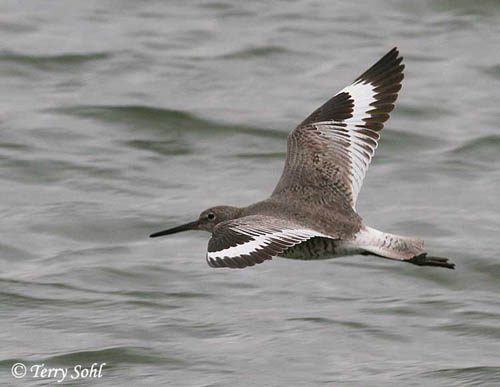
ID Keys: Black and white wing pattern in flight. Straight heavy
bill, thick gray legs, plain plumage when not in flight.
Willets appear to be rather plain, nondescript shorebirds when
at rest, but display a striking black-and-white wing pattern when in
flight. Willets have two distinct subpopulations, one nesting on the
freshwater marshes in the interior of the country, and another favoring salt
marshes along the Gulf and Atlantic coasts.
Habitat
Nests
near freshwater marshes in South Dakota, preferably near native
grasslands. Occurs in many aquatic habitats during migration and in
winter.
Diet
Varies depending on location. On the northern Great
Plains, insects make up a large portion of the diet. It also feeds on
crustaceans, small mollusks, small fish, and some vegetation. On wintering
grounds along the coasts, Willets consume large numbers of crabs and other
crustaceans, small fish, and marine worms.
Behavior
Forages by walking along the shore or in
shallow water, picking food items off the water or ground's surface, or by
probing with its bill.
Nesting
June in South Dakota. The Willet nests regularly in South Dakota, especially in prairie pothole wetlands, wet meadows, and grasslands near shallow water. Nests are simple ground scrapes lined with grasses, usually hidden among low vegetation, where females typically lay four well-camouflaged eggs. Both parents help defend the nesting territory aggressively, often giving loud calls and dive-bombing intruders that approach too closely.
Song
The Willet is well known for its loud, ringing “pill-will-willet” call, often given repeatedly in flight or when alarmed. Its vocalizations are sharp and highly conspicuous, making the species easier to detect than many other shorebirds in wetlands and along shorelines. Click to hear a Willet Call
Migration
The Willet is a regular spring and fall migrant in South Dakota, with numbers increasing noticeably during migration periods as birds move between northern breeding grounds and coastal wintering areas. Most migrants use wetlands, flooded fields, and lake shorelines as temporary stopover habitat before continuing south in late summer and fall.
Winters along coastlines of the U.S., Mexico, and Central America.
Greater Yellowlegs, Lesser
Yellowlegs. The Willet is larger and bulkier than both the Greater Yellowlegs and Lesser Yellowlegs, with a thicker bill, grayer overall plumage, and bold black-and-white wing patterns visible in flight. Greater and Lesser Yellowlegs are slimmer, more elegant birds with brighter yellow legs and finer bills, and both typically appear more lightly patterned and delicate than the heavier-bodied Willet. The Greater Yellowlegs also has a noticeably longer, slightly upturned bill compared to the shorter, straighter bill of the Lesser Yellowlegs.
Conservation Status
Numbers were seriously
depleted in the 19th century due to hunting pressure. Numbers have
recovered since, but local declines have been noted in some areas due to
habitat loss. Nonetheless, they are found over a very wide geographic area and
are quite common in parts of their range.
The IUCN considers the
Willet to be a species of "Least Concern".
Photo Information
April
30th, 2005 -- Highway 81 Lakes north of Madison -- Terry L. Sohl