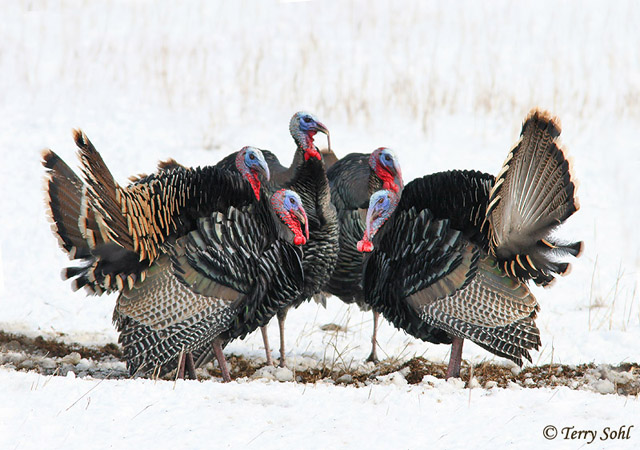
Wild Turkey numbers were seriously depleted by the beginning of the 20th century, numbers may have plummeted to a total population of 30,000 or less. However, as a popular game bird, introduction efforts were conducted in many areas and regulated hunting has limited the take for game. Numbers have since gradually increased, as has geographic range, and they are now quite common in much of the United States. Despite its large size, the Wild Turkey is a strong flier, and typically roosts at night in tall trees. Note the males courtship posture in many of the photos below, strutting with spread tail feathers for nearby females.
Habitat
Wild Turkeys can be found in a very broad array of habitats across North America, but typically are found in areas with both forested lands and adjacent clearings. In South Dakota, Wild Turkeys are found in riparian forests along our state's river systems, and in the bigger forested parks such as Newton Hills State Park, Good Earth State Park, or the Big Sioux Recreation Area. They are also quite comfortable around low-density human habitation, and are increasingly found around farmsteads and shelterbelts throughout the state.
Diet
Omnivorous. May feed on seeds, nuts, fruits, berries, roots, insects, snakes, frogs, lizards, and snails, with vegetative matter usually making up the majority of their diet. Particular favorite (dependent upon location) include acorns from multiple different oak species.
Behavior
Wild Turkeys forage by walking slowly along the ground, grabbing food items from the ground or low in the vegetation. They prefer to walk or run on the ground rather than take flight, and will typically choose to make an exit on the ground if they feel threatened, unless the danger is particularly close. Wild Turkeys are typically most active during dawn and dusk, but may be foraging at any time of the day. At night, these massive bulky birds roost in trees, often in large communal groups.
Nesting
April through July. The nest of a Wild Turkey is a shallow depression on the ground, lined with a bit of vegetative material. The female usually lays between 10 and 15 eggs, and she alone incubates them. When the eggs hatch, the young leave the nest almost immediately. The female will tend to the young and protect them, but the young feed themselves.
Song
Famed for the loud, gobbling calls given by courting and displaying males, they also have a variety of other clucking vocalizations.
- Click here to hear the gobbling song of male Wild Turkeys, recorded at Mammoth Cave National Park in Kentucky.1
- Click here to hear the nervous clucking of a disturbed female Wild Turkey, recorded in Hennepin County, Minnesota.2
- Click here to hear calls and other vocalizations given by 3 adult Turkeys, and a group of juveniles, recorded in Custer State Park, South Dakota.3
Migration
Generally permanent residents, although some may wander short distances in the fall.
Interactive eBird map
Click here to access an interactive eBird map of Wild Turkey sightings
Similar Species
Unique, not likely to be confused with another species.
South Dakota Hotspot
Not a rare species by any means, they do require some woodland stands, even if it's just a shelterbelt near a farmstead. However, the areas where they are likely the most common (in the eastern part of the state), they are in and around the riparian forests near the bigger rivers and streams.
Conservation Status
Wild Turkey populations in the US were drastically depleted by the mid-20th century, due to hunting pressures and habitat loss. Since then they have been steadily increasing in both range and in numbers, due to both natural reproduction and targeted reintroduction programs. Wild Turkeys are now found in every state except Alaska (yes, even in Hawaii!), and they are quite common in many parts of that range. The IUCN lists the Wild Turkey as a species of "Least Concern".
Photo Information
January 15th, 2012 - Minnehaha County, South Dakota - Terry Sohl
Audio File Credits
- 1Paul Marvin, XC153737. Accessible at www.xeno-canto.org/153737
- 2Jonathon Jongsma, XC134744. Accessible at www.xeno-canto.org/134744
- 3Jonathan Jongsma, XC104532. Accessible at www.xeno-canto.org/104532
